-
SERAP sued Akpabio and Abbas over alleged ₦3m ‘bribe-for-bills’ claims.
-
The group seeks a court order mandating investigation and prosecution.
-
SERAP insists the bribery claims breach Nigeria’s Constitution and UN laws.
The Socio-Economic Rights and Accountability Project (SERAP) has filed a lawsuit against the President of the Senate, Godswill Akpabio, and the Speaker of the House of Representatives, Tajudeen Abbas, over their alleged refusal to investigate claims that lawmakers pay between ₦1 million and ₦3 million to sponsor or present bills, motions, and petitions in the National Assembly.
EDITOR’S PICKS
- Trump Pushes for ‘Golden Fleet’ Warships to Counter China’s Growing Threat
- Former Oyo Catholic Bishop Julius Adelakun is Dead
- Nigeria to Deliver 4,000MW Renewable Energy Capacity Under ‘Nigeria First’ Policy
EKO HOT BLOG reports that the suit, numbered FHC/L/CS/2214/2025, was filed at the Federal High Court, Abuja. In it, SERAP is seeking an order of mandamus compelling Akpabio and Abbas—on behalf of all National Assembly members—to refer the bribery allegations to relevant anti-corruption agencies for full investigation and prosecution.
The legal action followed viral claims made by Ibrahim Auyo, a member of the House of Representatives representing Jigawa State under the All Progressives Congress (APC). In a video that circulated online, Auyo alleged that legislators are required to pay millions of naira before their bills or motions can be presented or considered in the chambers.
“Since I was elected as a member in 2015, no individual has given me a bill to pass. Even bills and petitions are paid for. You have to pay between ₦3 million and ₦1 million to present it,” Auyo said in Hausa.
In its suit, SERAP described the alleged practice as “a grave violation of public trust and constitutional duty.” The group maintained that the supposed monetization of legislative processes “undermines the authority of the National Assembly and erodes public confidence in democratic governance.”
“Lawmakers should not have to pay bribes to present motions or bills,” SERAP stated. “Bribery should never influence the exercise of legislative duties.”
The group also urged the court to compel Akpabio and Abbas to ensure the protection of Ibrahim Auyo as a whistleblower under Article 33 of the UN Convention Against Corruption, to which Nigeria is a signatory.
SERAP’s lawyers, Kolawole Oluwadare, Kehinde Oyewumi, and Andrew Nwankwo, argued that the National Assembly’s failure to act contravenes Section 15(5) of the 1999 Constitution, which mandates all public institutions to “abolish corrupt practices and abuse of power.”
According to SERAP, Nigeria has made binding commitments under the UN Convention against Corruption, and failure to uphold these obligations would “entrench a culture of impunity in the legislature.”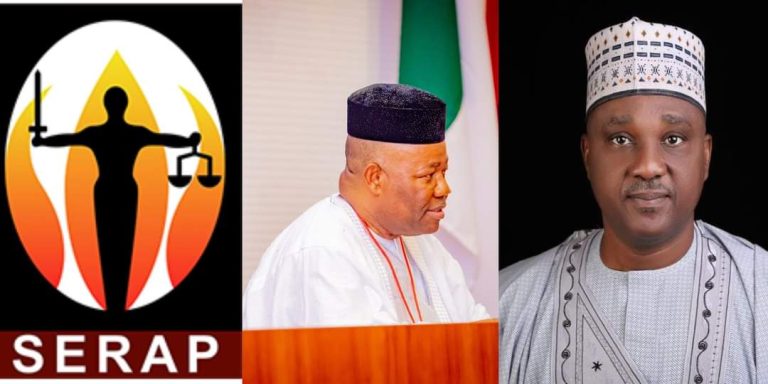
As of press time, neither Akpabio nor Abbas has issued an official statement regarding the bribery claims, and no internal investigation has been announced. The case has yet to be assigned a hearing date.
FURTHER READING
- Obasanjo Explains Why He Rejected El-Rufai as Successor
- NOA Launches ₦22m Animation Contest to Promote National Values
- Gombe Commissioner Dies in Road Accident