- Commenting on the reported killings, Katz stated that Israel is continuing efforts to dismantle Iran’s leadership and military capabilities
- In a message shared a day earlier, Larijani urged Muslim-majority nations to support Iran
- Reports from journalists indicate that Israeli and US strikes have targeted multiple locations across Iran, including Tehran, Ahvaz, Isfahan and Shiraz
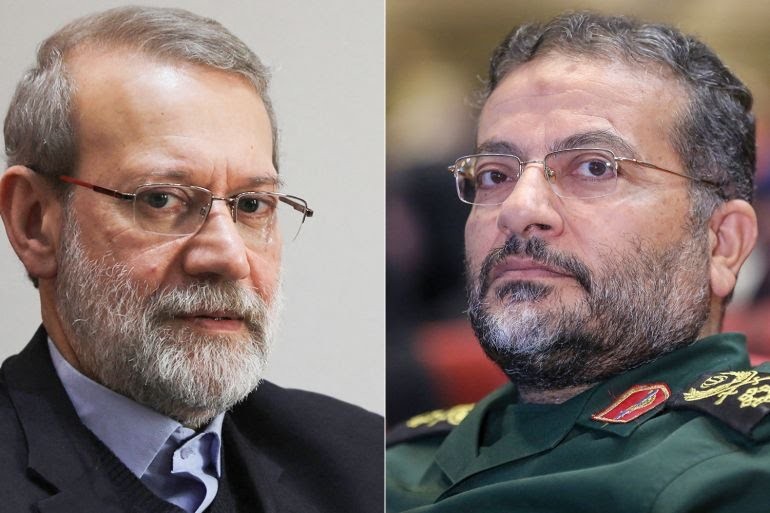
Israel has announced that it killed senior Iranian officials, including Ali Larijani, secretary of Iran’s Supreme National Security Council, and Gholamreza Soleimani, head of the Basij militia. However, Iranian authorities have not confirmed or denied either claim.
Eko Hot Blog gathered that the announcement regarding Larijani was made on Tuesday by Israel’s Defence Minister, Israel Katz.
EDITOR’S PICK
- Why Return of Lagos Monthly Sanitation Exercise is Long Overdue
- Four Killed as Truck Crashes Into Bus on Lekki–Epe Expressway
- Uzodimma: Tinubu Reforms Prevent Fuel Crisis
Despite the claim, Iranian state media released a handwritten message attributed to Larijani, though it remains unclear whether it was meant to prove he is still alive.
The note paid tribute to 84 Iranian sailors reportedly killed in a recent US attack on a naval vessel.
If verified, Larijani’s death would mark one of the most significant losses for Iran since earlier strikes by US and Israeli forces reportedly killed former Supreme Leader Ayatollah Ali Khamenei and members of his family at the onset of the conflict on February 28.
Larijani, a prominent figure in Iranian politics, was last seen publicly on Friday during an Al-Quds Day rally in Tehran alongside President Masoud Pezeshkian. Over the years, he has held several key roles, including leading Iran’s nuclear negotiations and serving as speaker of parliament.
Commenting on the reported killings, Katz stated that Israel is continuing efforts to dismantle Iran’s leadership and military capabilities, particularly its missile systems and strategic infrastructure.
In a message shared a day earlier, Larijani urged Muslim-majority nations to support Iran, criticizing what he described as a lack of solidarity in the face of US and Israeli actions.
He framed the conflict in religious and political terms, calling on Islamic countries to take a clear position while insisting Iran does not seek dominance over its neighbours.
Reports from journalists indicate that Israeli and US strikes have targeted multiple locations across Iran, including Tehran, Ahvaz, Isfahan and Shiraz.
Separately, the Israeli military said it carried out a targeted airstrike in Tehran that killed Gholamreza Soleimani, who had led the Basij paramilitary force for several years.
The Basij, affiliated with the Islamic Revolutionary Guard Corps, plays a major role in Iran’s internal security operations. Iran has yet to confirm this claim.
Analysts suggest that while such high-profile attacks may carry symbolic and psychological weight, they are unlikely to destabilize Iran’s leadership structure entirely, as replacements typically emerge quickly.
Gholamreza Soleimani, born in 1965 according to US records, had faced sanctions from the United States, European Union and other countries over alleged involvement in suppressing protests.
The Basij force has long been active in enforcing internal control, including during major anti-government demonstrations in recent years.
Since the conflict began, Iran’s internal security institutions, including the Basij, have been frequent targets of US and Israeli military operations.
FURTHER READING