- The Federal Government has revealed that Nigeria is currently hosting more than 100,000 registered refugees and asylum seekers, predominantly originating from neighboring nations within the volatile Lake Chad Basin region.
- To effectively address the protracted nature of the humanitarian crisis, administrators are shifting operational frameworks from temporary palliatives to structural pathways by actively linking immediate relief to agribusiness and long-term economic development.
- Plans are officially underway to expand the parameters of the National Social Register, enabling a data-driven, transparent integration of displaced populations and their respective host communities into national social protection programs.
The Federal Government has disclosed that Nigeria is currently providing asylum and humanitarian coverage to over 100,000 foreign refugees, even as millions of its own citizens continue to grapple with severe internal displacement.
Eko Hot Blog reports that the disclosure was made by the Secretary to the Government of the Federation, Senator George Akume, on Monday, June 22, 2026, in Abuja during the formal commemoration of the 2026 World Refugee Day, themed “Until Everyone is Safe.”
EDITOR’S PICK
- Hamzat Appoints Obanikoro as Campaign DG Ahead of 2027 Lagos Governorship Race
- Tinubu’s State Police Plan Gains Momentum as Amendment Looms
- Residents Raise Alarm After Two Bodies Found in Lagos Waterway
According to a state communiqué released by the Head of Information and Public Relations for the Office of the Secretary to the Government of the Federation, Chris Ugwuegbulam, the government’s comprehensive management strategy is anchored upon three non-negotiable operational pillars: protection, livelihoods, and durable solutions.
These interventions are being actively driven by the National Commission for Refugees, Migrants and Internally Displaced Persons.
Senator Akume emphasized that the administration of President Bola Tinubu is working to ensure that vulnerable populations do not merely survive on handouts but are systematically integrated into sustainable agribusiness opportunities, education networks, and long-term socio-economic frameworks.
Compounding the foreign refugee burden is Nigeria’s intense domestic displacement crisis, catalyzed by decades of regional insurgency, banditry, communal clashes, and escalating climate-induced environmental disasters, particularly across the North-East.
Speaking at the Abuja event, the Minister of Humanitarian Affairs and Poverty Reduction, Dr. Bernard Doro, lauded the immense resilience displayed by displaced persons globally.
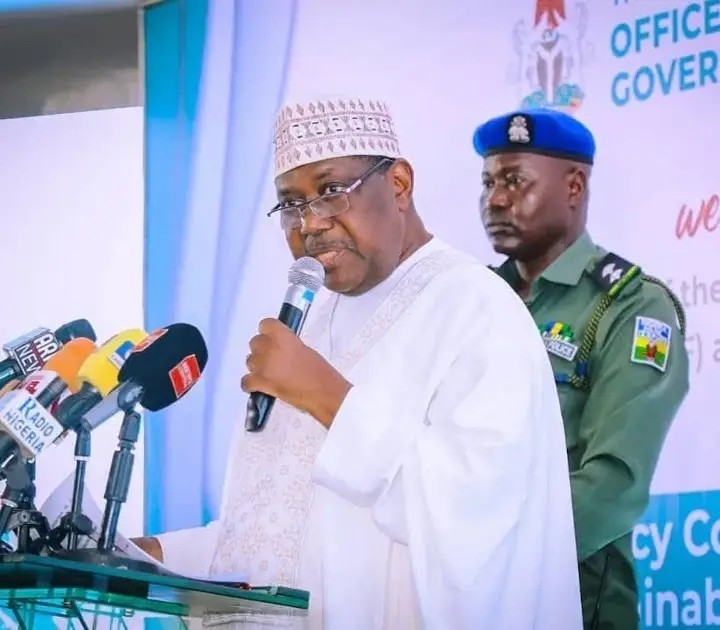
He reaffirmed Nigeria’s unwavering allegiance to international humanitarian protocols and appealed directly to corporate entities, developmental partners, and host communities to double down on investments that foster self-reliance among refugees.
In his briefing, the Federal Commissioner and Chief Executive Officer of the NCFRMI, Aliyu Tijani Ahmed, stated that practical solidarity must eclipse mere rhetorical sympathy.
Ahmed stressed that comprehensive protection must legally include guaranteed access to quality healthcare, legal identity documentation, standard shelter, and social services.
To streamline this process, the Federal Government is leveraging advanced field metrics to expand the National Social Register, a move designed to ensure that future resource distributions are entirely data-driven, transparent, and dignified for both the displaced persons and the rural communities absorbing them.