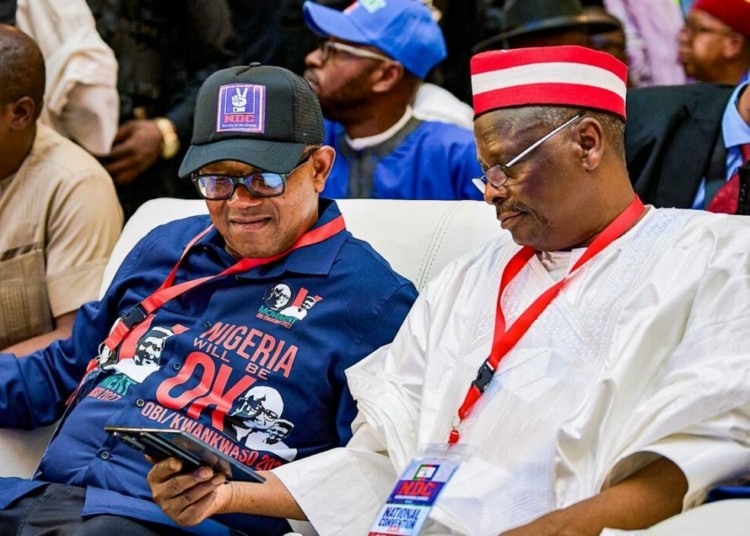
Rabiu Musa Kwankwaso, running mate to Peter Obi of the Nigeria Democratic Congress (NDC), says an Obi-Kwankwaso government would talk with terrorists and criminals to end Nigeria’s insecurity.
Speaking on Channels Politics Today on Monday, Kwankwaso said communities living with insurgency know the identities and locations of attackers, but do not trust security agencies enough to share the information. “We will work with the people, even the terrorists, and of course, the criminals themselves to see what can be done to discourage their action,” he said.
EDITOR’S PICKS
His comments echo Obi’s own remarks in June, when the former Anambra governor told Rufai Oseni on BlackBox that he would negotiate with any bandit or armed group “genuinely willing to embrace peace,” while promising war for those who want war.
Nothing New Here
Talking to terrorists is not a new idea in Nigeria. Negotiation has been tried, in one form or another, since Boko Haram’s violence began in 2009. The Goodluck Jonathan government explored back-channel talks with the sect. The Buhari administration negotiated prisoner swaps that freed dozens of Chibok and Dapchi schoolgirls.
Since 2016, the military has run Operation Safe Corridor, a deradicalisation and reintegration scheme for surrendered fighters. Bandit “repentance” ceremonies have played out repeatedly across Zamfara, Katsina and Niger states.
So when Obi and Kwankwaso present dialogue as a solution, they are not proposing anything groundbreaking. Nigeria already has 16 years of experience with talking to armed groups. What is missing from the NDC ticket’s pitch is any account of why this time would be different, or what specific mechanism would make negotiation succeed where previous rounds have not stopped the killing.
A Plan Without New Ideas
Neither candidate has laid out how their government would identify who is worth talking to, what would be offered in exchange for peace, or how compliance would be monitored and enforced.
Kwankwaso’s answer largely restates a known problem, that communities have intelligence they are afraid to share, without offering a concrete fix beyond a vague promise to “give people confidence.”

A serious counter-terrorism plan needs specifics on trust-building, protection for informants, and consequences for groups that talk peace while still attacking. So far, none of that has been offered.
The US Comparison Doesn’t Hold
Obi’s example of an American university staffed by former prisoners, cited as proof that people who have “made mistakes” deserve a second chance, is a weak comparison. Most people who serve prison time in the US do so for non-violent, financial, or personal offences, not for waging an ideological campaign of mass killing. Even where the offence was violent, it is typically a single act, not a sustained campaign.
Terrorism in Nigeria’s north-east and armed banditry in the north-west are different.
Boko Haram and its ISWAP offshoot are not people who slipped once. They operate on a declared ideology built around religious extremism and the violent rejection of the Nigerian state. Their goal is to kill, destroy and control territory, not to survive a moment of desperation. Negotiation assumes a shared interest in peace. It is unclear what interest a group built entirely around violence has in giving it up, beyond buying time to regroup.
Lawmakers Have Already Said No
The rehabilitation approach that Obi and Kwankwaso appear to be gesturing toward has just been rejected by Nigeria’s own National Assembly. In early July, the Senate voted to demand an end to the rehabilitation of repentant Boko Haram members, following the killing of retired Major General Rabe Abubakar and other officers by bandits. The House of Representatives followed with its own resolution days later, with lawmakers arguing that people who kidnap, torture and kill do not deserve reintegration into society.
FURTHER READING
The resolutions are not binding on the executive, and the Tinubu government has pushed ahead with a new reintegration framework regardless. But the pushback from both chambers shows where public and political mood is heading, away from leniency, not toward it. An NDC government promising more talking would be swimming against a current that its own National Assembly has already tried to reverse.
Philip Ibitoye is a Special Correspondent with EKO HOT BLOG. Click here to find daily analysis and critical insight on trending issues in Lagos and other parts of Nigeria.
Click to watch the video of the week below: