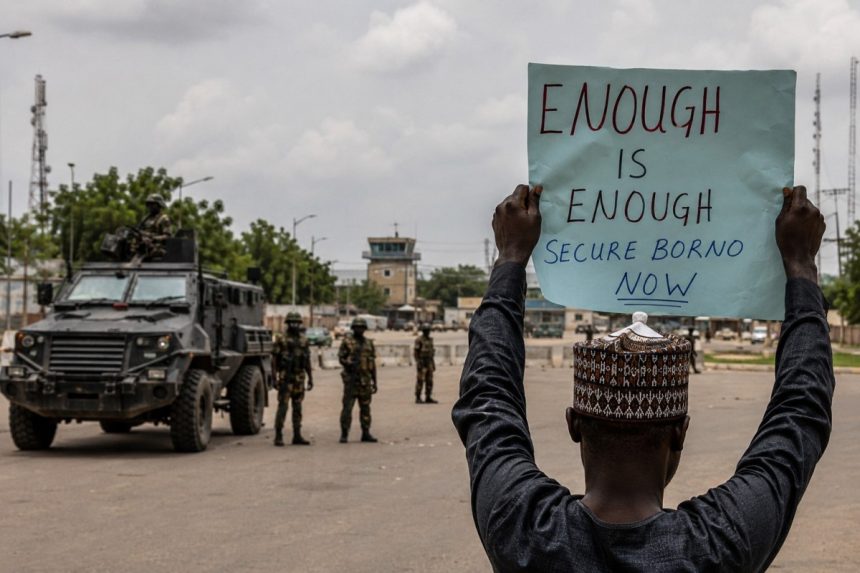
The protest was conceived by residents and youth groups seeking to draw attention to the worsening security situation in parts of Borno State, particularly the growing concerns over attacks, abductions and the prolonged suffering of communities that have spent years living under the shadow of insurgency.
EDITOR’S PICK
- Gov. Alex Otti Says Slashed State Debt by 60%, Completes 414 Roads In Few Years
- Nwoko Rejects APC Delta North Primary Result, Claims Victory Over Okowa
- Lagos Expands Infrastructure at Agbowa Timberville Project in Epe
However, what was expected to become a peaceful expression of public concern ended before it began after reports emerged of the deployment of military personnel and armoured vehicles to Filling Polo, the proposed venue of the demonstration.
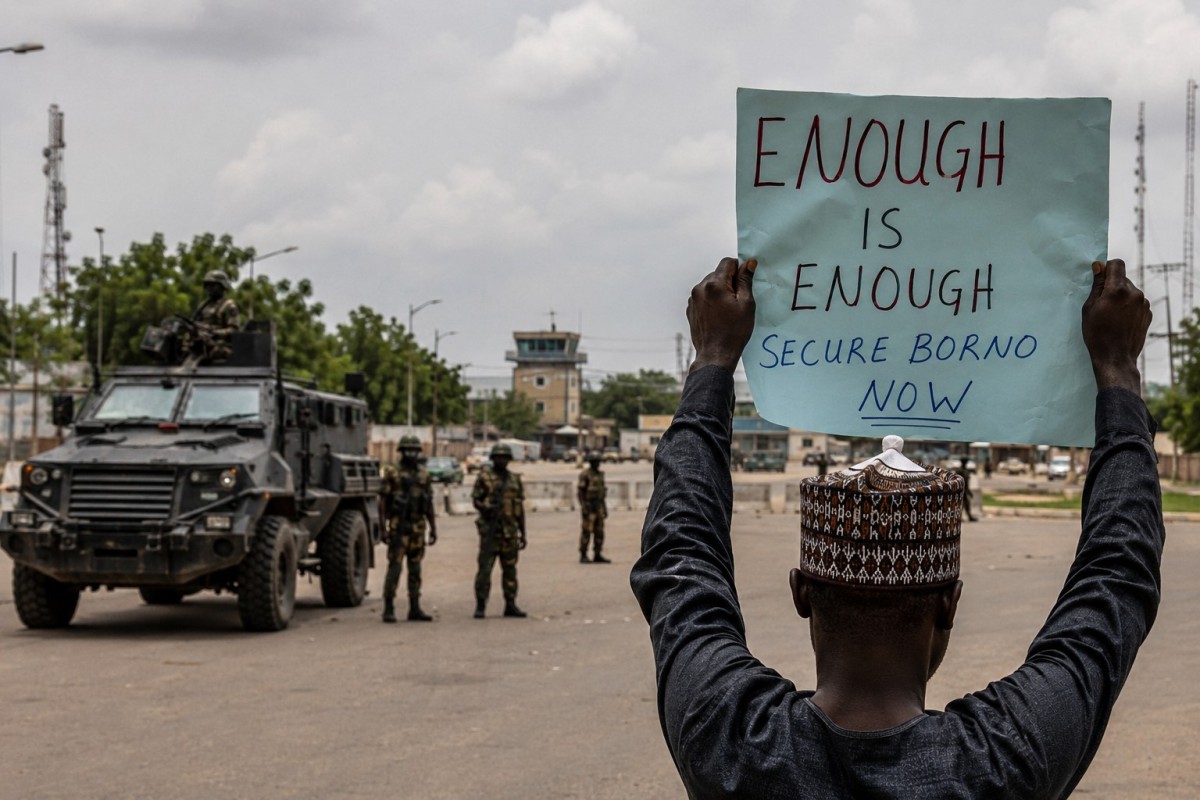
According to organisers, the development created fear among intended participants and eventually led to the postponement of the protest.
The significance of this development lies beyond the cancellation itself. It touches on the larger question of how a democratic society responds when victims of conflict attempt to publicly express their pain and demand stronger action from the state.
Borno occupies a unique place in Nigeria’s contemporary history because no other state has carried the burden of insurgency with such intensity and for such an extended period.
For well over a decade, communities across the state have experienced repeated attacks, destruction of property, displacement, kidnappings and the painful loss of loved ones. Thousands of residents have been forced from their homes, while many families continue to live with the uncertainty surrounding relatives who disappeared during attacks or were taken by insurgents.
The conflict has reshaped entire communities and altered the social and economic realities of many residents.
Agricultural activities that once sustained rural livelihoods have been disrupted in several communities. Schools have been affected by insecurity. Businesses have struggled to survive in conflict affected areas. Families that once lived stable lives have been pushed into humanitarian crises.
These experiences explain why insecurity in Borno cannot be discussed merely through casualty figures or official statements.
Behind every statistic lies a personal story.
There are parents searching for abducted children, widows attempting to rebuild their lives after losing breadwinners, displaced persons adapting to unfamiliar environments and communities trying to recover from repeated trauma.
It was this reality that reportedly informed the planned protest.
According to organisers, some participants were expected to come from communities directly affected by insecurity and abductions, including areas where residents continue to seek answers about relatives still in captivity.
For these individuals, the protest was not simply a political exercise. It represented an attempt to make visible a suffering that many believe has not received sufficient attention.
Security authorities have consistently maintained that demonstrations and public gatherings must comply with established procedures, especially in conflict sensitive environments where security threats remain active.
Such concerns cannot be dismissed lightly, particularly in a state that continues to confront insurgency and other security challenges.
Authorities have legitimate responsibilities to prevent violence, maintain order and ensure that public gatherings are not exploited by criminal elements.
Nevertheless, these responsibilities must coexist with the constitutional rights of citizens to peaceful assembly and civic participation.
Democratic societies derive strength not from the suppression of public expression but from their ability to accommodate dissent, grief and demands for accountability within lawful frameworks.
Citizens affected by insecurity should not feel alienated from institutions established to protect them.
Rather, public engagement should be viewed as an opportunity to understand community concerns and reinforce trust between the state and the people.
The broader concern raised by the events in Maiduguri is the growing perception that civic expressions increasingly encounter obstacles at moments when citizens seek answers to urgent national problems.
Nigeria has, in recent years, witnessed numerous demonstrations linked to economic hardship, governance concerns and insecurity.
These developments have repeatedly raised questions about the balance between security management and civic freedoms in a democratic environment.
The situation in Borno deserves particular sensitivity because the people of the state have already paid an enormous price.
Years of insurgency have left deep social, economic and psychological wounds across communities.
Many residents continue to live with memories of attacks, displacement and personal loss.
For such communities, the opportunity to peacefully express concerns should not become another source of anxiety.
The cancellation of the protest may have brought the immediate event to an end, but it did not remove the frustrations and fears that motivated it.
Communities still desire greater security.
Families still seek the return of missing relatives.
Residents still hope for a future free from violence and uncertainty.
The challenge before government and security institutions therefore extends beyond responding to protests.
It requires rebuilding confidence, strengthening protection for vulnerable communities and assuring citizens that their pain is recognised and their voices remain important within the democratic process.
For the people of Borno, the demand has remained consistent through the years.
They seek security, peace and the opportunity to rebuild lives interrupted by conflict.