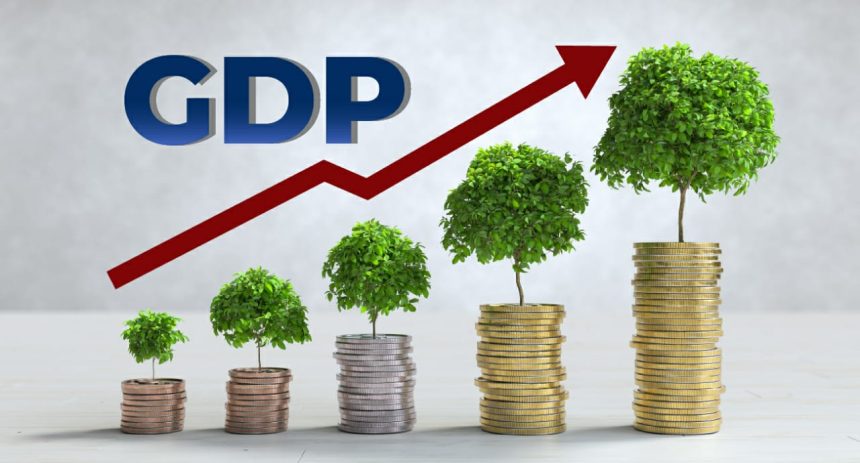
Nigeria ended 2025 on a stronger economic footing. The National Bureau of Statistics (NBS) announced on Friday that the country’s gross domestic product (GDP) grew by 4.07 percent in the fourth quarter of 2025, up from 3.76 percent in the same period a year earlier.
The figure lands at a moment when economic conditions are shifting: inflation, which had weighed heavily on Nigerians for years, has now fallen for ten consecutive months to its lowest point since late 2020.
EDITOR’S PICKS
Taken together, easing prices and rising output offer the most encouraging economic picture Nigeria has seen in some time. EKO HOT BLOG digs throught the numbers and what they signal.
A Broad-Based Recovery, Not Just an Oil Story
The encouraging part of this GDP report is that growth did not come from one source alone. Agriculture grew by 4.00 percent, up sharply from 2.54 percent in Q4 2024. Industry rose to 3.88 percent from 2.49 percent. These are the sectors that employ the most Nigerians, so their improvement matters beyond the headline figure.
The services sector, which now accounts for nearly 56 percent of the entire economy, also grew by 4.15 percent. This was driven by telecommunications, financial services, real estate, and trade. In plain terms, more transactions, more digital activity, and more business deals were happening across the country in the final quarter of 2025.
Even the oil sector posted real growth of 6.79 percent year-on-year, with daily production averaging 1.58 million barrels, slightly above the 1.54 million recorded in Q4 2024. While oil remains a relatively small slice of the GDP pie at 2.87 percent, its contribution is stabilising. More importantly, the non-oil sector contributed 97.13 percent of real GDP, which signals that Nigeria’s economic diversification, though still a work in progress, is slowly gaining ground.
The Full-Year Picture: 2025 Was Better Than 2024
Looking beyond a single quarter, the annual numbers tell an even more complete story. Nigeria’s economy grew by 3.87 percent across all of 2025, compared to 3.38 percent in 2024. That may not sound dramatic, but in the context of the structural challenges Nigeria has faced — fuel subsidy removal, naira devaluation, and a prolonged cost-of-living crisis — it represents real momentum.
Nominal GDP — that is, the raw value of goods and services without adjusting for inflation — stood at N122.81 trillion in Q4 2025, up from N104.47 trillion in Q4 2024. That is a 17.55 percent nominal increase. While inflation accounts for part of this jump, the real growth figures confirm that actual economic output did expand.
What This Means Going Forward
A 4.07 percent growth rate is positive news, but it should be read with caution. Nigeria’s population is growing at roughly two percent per year, meaning that per capita economic gains — what actually reaches individuals — remain modest. For growth to be felt in people’s pockets, it needs to be sustained, accelerate beyond current levels, and be better distributed across regions and income groups.
Still, the direction of travel is encouraging. Agriculture and industry growing faster than they did in 2024 suggests that some of the reforms of the past two years, painful as they have been, are beginning to yield results. If the government can maintain fiscal discipline, attract investment into manufacturing and agriculture, and keep oil production stable, the conditions exist for Nigeria to build on this momentum in 2026.
FURTHER READING
The Q4 2025 GDP report is not a declaration of victory. It is, however, evidence that Nigeria’s economy is moving in the right direction and after years of turbulence, that is no small thing.
Philip Ibitoye is a Special Correspondent with EKO HOT BLOG. Click here to find daily analysis and critical insight on trending issues in Lagos and other parts of Nigeria.
Click to watch the video of the week below: