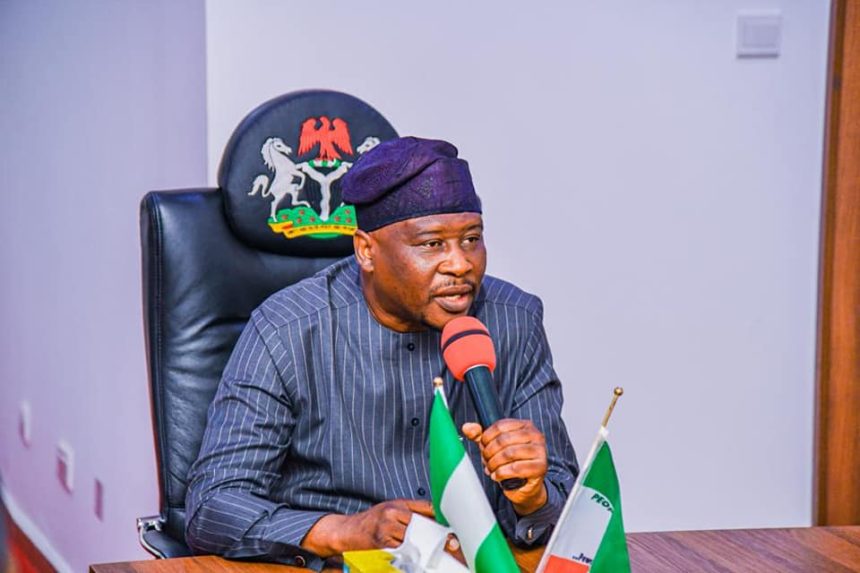
Adamawa State Governor Ahmadu Fintiri is the latest opposition governor to join the All Progressives Congress (APC) and cite an intention to attract greater federal support as reason.
Fintiri formally crossed to the ruling party on Friday. His motive for moving to the APC, he said, was a strategic step to attract greater federal presence and accelerate development projects in his state. He has not been alone in that reasoning.
EDITOR’S PICKS
Akwa Ibom Governor Umo Eno made the same case in June 2025, saying he moved from the PDP to the APC to “align the state with the centre” and attract more federal presence. In Bayelsa, an official of the South-South Development Commission said publicly that Governor Douye Diri would attract more federal projects if he joined the APC.
It’s the same story with other governors who have defeated to the ruling party in the last year, including, but not limited to, Kano State Governor Abba Yusuf and Taraba State Governor Agbu Kefas.
With the APC now controlling roughly 30 of Nigeria’s 36 states, the trend raises a question that goes beyond party politics: is this how a federal democracy is supposed to work?
A Broken Promise at the Heart of Federalism
In a genuine federal system, every state, regardless of which party controls it, is entitled to its constitutionally guaranteed share of national resources. Nigeria’s 1999 Constitution provides for a Federation Account from which states receive statutory allocations. Federal infrastructure projects, in theory, follow need and planning, not political loyalty.
But the lived experience of Nigerian politics has long diverged from that ideal.
Governor Dauda Lawal of Zamfara, one of the few remaining PDP holdouts, put it plainly when he alleged that APC-aligned states had collectively received over N500 billion in federal support that his state was effectively excluded from.
He vowed to stay in the PDP, but his allegation itself tells a story. When governors publicly confess they need to switch parties to unlock roads, hospitals, and power projects for their people, it is an admission that federalism, as practiced, is not working.
This is not a new problem, and it is not unique to the APC. Governors scrambled to align with Goodluck Jonathan’s PDP for the same reasons, and the same pressures existed under past administrations. The pattern predates any single party. What is new is the scale and the brazenness with which the transactional nature of Nigerian federalism is now being openly admitted.
Democracy’s Warning Signs
A ruling party that controls 30 of 36 states is not, by itself, evidence of democratic failure. Voters choose governments, and a popular president can inspire genuine support at the state level. But when governors defect not because their constituents’ values have changed, but because their budgets depend on it, the democratic contract is quietly being broken.
The voter who elected a PDP governor for PDP reasons did not vote for a political calculation made in Abuja boardrooms. The Kabiru Turaki-led PDP faction called Fintiri’s defection “an exhibition of unrestrained cowardice.” That is partisan language, but the underlying concern is legitimate: when governors jump ship for federal favours, accountability to the electorate is replaced by accountability to the presidency.
Opposition politics, which is the engine of democratic competition, cannot survive if opposition governments are systematically starved of resources. Checks and balances erode. The incentive to vote for local leadership weakens when that leadership’s effectiveness is determined not by competence but by proximity to power in Abuja.
The Future Nigeria Must Choose
Nigeria’s constitution and its institutions need to be strong enough that a governor in opposition does not have to apologise to his people for their party affiliation. That requires reform: stronger revenue transparency from the Federation Account, independent oversight of federal capital allocations, and courts willing to enforce equitable treatment across states.
But reform alone is not enough. Nigerian civil society, the press, and voters must hold governors accountable for the reasoning they offer. When an elected official says “I joined this party so you can get a road,” they are conceding that politics, not governance, decides who gets basic infrastructure. That should alarm citizens, not reassure them.
The governors defecting today may be acting in what they see as their states’ immediate interests. But the politics they are normalising, where party alignment is a prerequisite for federal presence, poisons the well for every future administration, from every party.
FURTHER READING
A Nigeria where the next president, of any political colour, can use infrastructure as a tool of political consolidation is not a Nigeria where democracy is maturing. It is one where the rules of the game are quietly being rewritten, and not in favour of the governed.
Philip Ibitoye is a Special Correspondent with EKO HOT BLOG. Click here to find daily analysis and critical insight on trending issues in Lagos and other parts of Nigeria.
Click to watch the video of the week below: