- Brent crude climbed to $107.92 and US crude to $102.57 after Iran’s parliament speaker warned that forces are “waiting” for American troops, heightening fears of a ground war.
- Beyond the closed Strait of Hormuz, Yemen’s Houthi rebels now threaten the Bab al-Mandab Strait, risking a total blockade of 20% of the world’s daily oil flow.
- Pakistan, Saudi Arabia, Egypt, and Turkey are coordinating urgent talks to facilitate a meeting between the US and Iran in the coming days to prevent a global recession.
Global energy markets remained on edge this Monday, March 30, 2026, as oil prices continued their upward trajectory following a stern warning from Tehran.
Eko Hot Blog reports that despite President Donald Trump’s recent extension of an ultimatum regarding the Strait of Hormuz, Iran’s parliamentary leadership signaled a readiness for direct military confrontation should US forces initiate a ground invasion.
EDITOR’S PICKS
- Judge Frees 37 Inmates Over Prolonged Detention in Akwa Ibom
- Trump Threatens Iran Over Energy Attacks
- Tinubu Excludes Kemi Badenoch from UK State Visit Itinerary
This rhetoric has pushed Brent crude, the international benchmark, up by nearly 2.5%, reflecting deep anxieties over what is already being called the largest oil disruption in history.
The conflict has moved beyond a bilateral standoff, with the Iran-backed Houthi rebels in Yemen launching strikes that threaten the Bab al-Mandab Strait.
This secondary chokepoint is vital for Red Sea shipping, and its potential closure could effectively sever major global energy corridors.
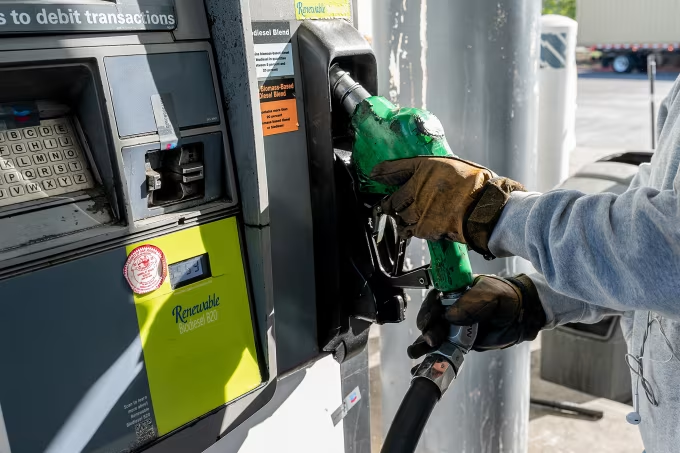
The impact is being felt acutely at the pump; American citizens are now paying an average of $3.98 per gallon, a direct consequence of strikes on major production facilities like Qatar’s Ras Laffan earlier this month.
Industry experts warn that the economic fallout may lead to a “brutal” correction.
Bob McNally, president of Rapidan Energy, suggested that if prices continue to spiral, the resulting global recession might be the only factor capable of artificially “killing” demand to cap costs.
Meanwhile, a diplomatic quartet led by Pakistan is racing against time to broker a ceasefire. Pakistan’s Foreign Minister Ishaq Dar described recent meetings as “very productive,” with plans to facilitate direct US-Iran dialogue within days.
As stock futures tumble in response to the instability, the focus remains on whether diplomacy can outpace the drums of war.
Even if a deal is reached, analysts caution that gas prices will be slow to retreat due to the extensive damage inflicted on regional infrastructure.
For now, the global economy hangs in the balance, tethered to the volatile security situation in the Middle East.