For years, Nigeria’s education sector has heard grand promises. Budget speeches came and went, ministers cut ribbons, and yet classrooms stayed dark, hostels stayed unsafe, and graduates stayed jobless. Reform, for the most part, was a word — not a plan. Teachers went unrecognised, students walked kilometres to lecture halls, and university staff turned to loan sharks just to survive. The sector needed more than sympathy. It needed structure.
- Let There Be Light: How RHEEP Rewired Campus Life
- No More Trekking: The Tricycles Changing Campus Commutes
- From Idle Hands to Skilled Hands: TVET’s Quiet Revolution
- Pitch, Win, Build: Students Cashing In on Big Ideas
- From Tenant to Landlord: TISSF’s Lifeline for Campus Workers
- Teachers’ Reward No Longer in Heaven Only
Enter Dr Tunji Alausa. A trained nephrologist, he had barely settled into his role as Minister of State for Health — just over a year in the job — when President Bola Ahmed Tinubu redeployed him to lead the Federal Ministry of Education on October 23, 2026. Many wondered what a doctor could bring to classrooms and lecture theatres.
EDITOR’S PICKS
The answer came fast: in under two months, Alausa had unveiled the Nigeria Education Sector Renewal Initiative (NESRI) — a six-pillar roadmap built to fix what decades of lip service had failed to touch.
The six pillars include Technical and Vocational Education Training (TVET), Science, Technology, Engineering, Mathematics and Medical Sciences (STEMM), Out-of-School and Almajiri reintegration, Girl-Child Education, Data and Digitisation, and Education Quality Assurance.
Numbers tell one story. But behind every disbursement is a person whose daily life has quietly changed; a medical student who can finally see her specimens under light, a staff member who now owns a house, a teacher recognised for the first time in decades of quiet service. These are the stories of NESRI’s impact.
A new documentary produced by the Ministry of Education features beneficiaries of these reforms telling those stories.
Let There Be Light: How RHEEP Rewired Campus Life
Unreliable power was never just an inconvenience on Nigerian campuses; it disrupted lectures, spoiled lab specimens and made hostel life harder.
RHEEP, implemented by the Rural Electrification Agency (REA), is now powering 37 federal universities and seven teaching hospitals with solar energy.
University of Abuja (UniAbuja) medical student Mercy Dauda, in a video published by the Ministry of Education, explained that electricity was vital to medical students because their lectures were mostly practical. But poor electricity on campus made classes unpleasant for her and her coursemates.

The university’s SUG President Yusuf Jamilu also revealed that the campus used to bleed valuable materials: “Our tissue specimens and chemical reagents on campus, due to lack of electricity where we can’t be able to refrigerate them, we usually lose them.”
But RHEEP has turned the story around, lighting up campuses and changing the experiences of students for the better.
For Ugochukwu Nelson of Michael Okpara University of Agriculture, the change is personal. He once missed a 300-level assignment because his hostel had no light, but says “with this [RHEEP], I don’t think that is a problem again. It has really bridged that divide.”

Dean of Student Affairs at UniAbuja, Prof Simon Malamkawe, called RHEEP “one of the most potent or important programmes of this current administration.” “It has helped me particularly as an academic staff in the delivery of my academic activity such as lectures and conducting practicals,” Malamkawe added.
No More Trekking: The Tricycles Changing Campus Commutes
Getting around sprawling campuses used to eat into students’ time and pockets.
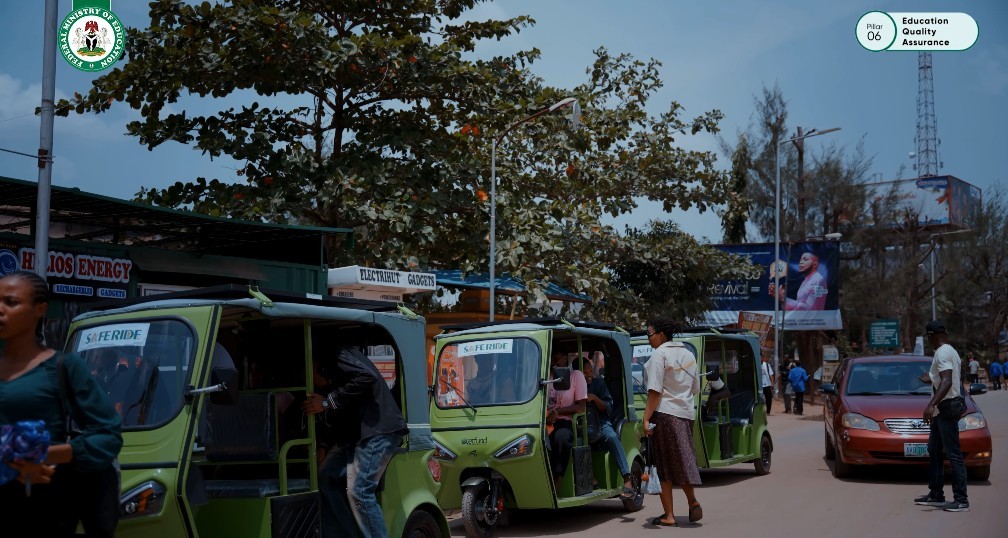
Through the Federal Ministry of Education and TETFund, electric tricycles now move students at a standardised fare of N100 per trip.
Bayero University Kano student, Omar Faruk Turakeey remembers the old routine: “Every single time I had to attend lectures, it used to take 45 minutes to walk down from my hostel to lecture hall.”
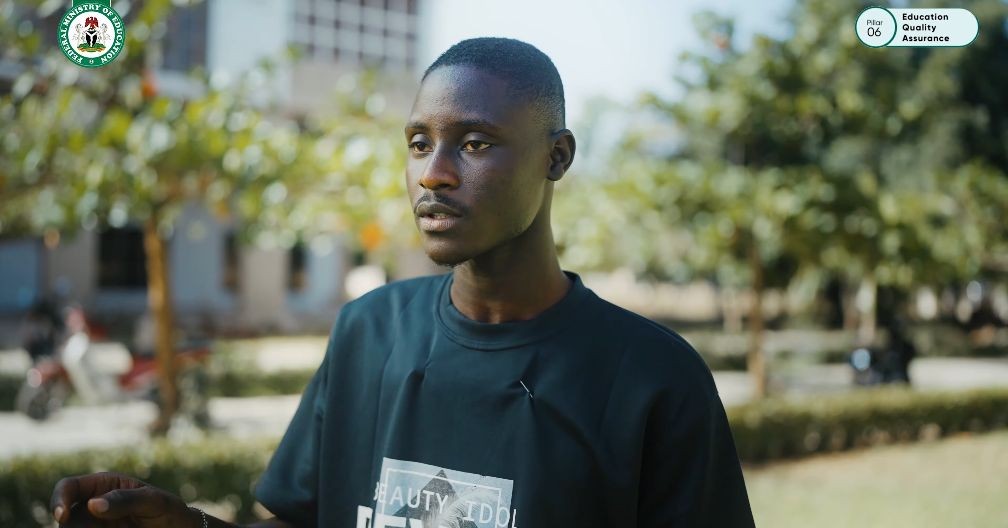
Another student described the financial relief in blunt terms: “I used to spend approximately 10,000 Naira per month just on transportation… which now I just spend nothing more than N4,000 per month.”
TETFund’s Executive Secretary, Arc. Sonny Echono, said the fund stepped in “because of the need to provide solace to the students.”
Prof Ugochukwu Stanley, Vice-Chancellor of Nnamdi Azikiwe University, Awka, said the initiative gives students reduced-cost transport “so that the students do not suffer so much after the removal of the subsidy.”
From Idle Hands to Skilled Hands: TVET’s Quiet Revolution
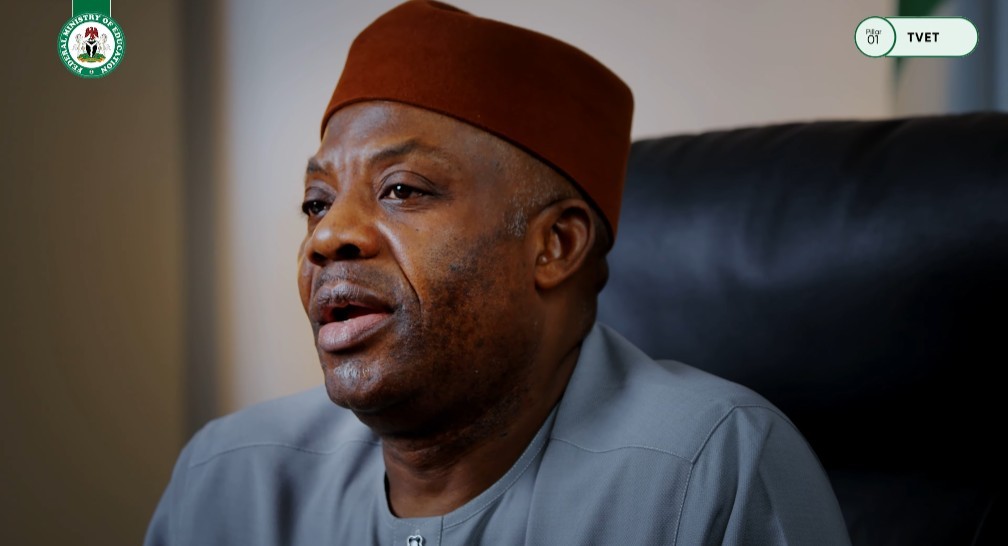
TVET is turning idle hands into skilled ones. It has drawn 1.3 million applications, connected 250,000 Nigerians to accredited centres, and pays a monthly stipend of N22,500.
Kano trainee Juwairiya Sammari almost didn’t apply, tired of every “link, link, link” sent her way until a friend convinced her: “This is a federal government programme and I should give it a try.”
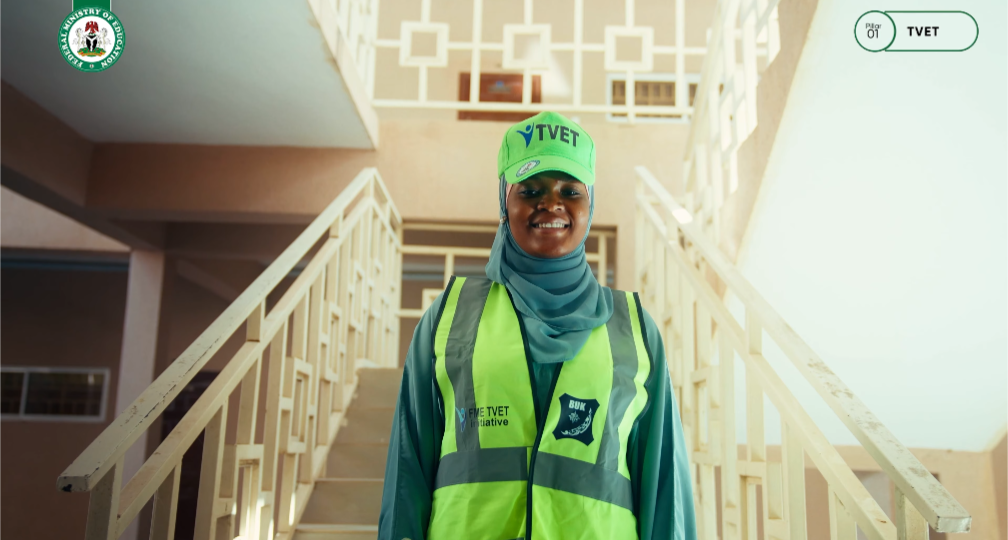
Victory Uchendu, once a truck driver in Abia State, found in TVET a chance to switch careers.
Minister of State for Education, Prof Suwaiba Sa’id Ahmed, said training at Bayero University’s centre already covers “fashion design and garment making, heavy solar installation and maintenance, CNG conversion and maintenance, and also beauty cosmetology.”
For Lagos trainee Osodi Joy, the impact is generational: “When I’m done, they have a fashion designer in the house… it will bring in more income to my family.”
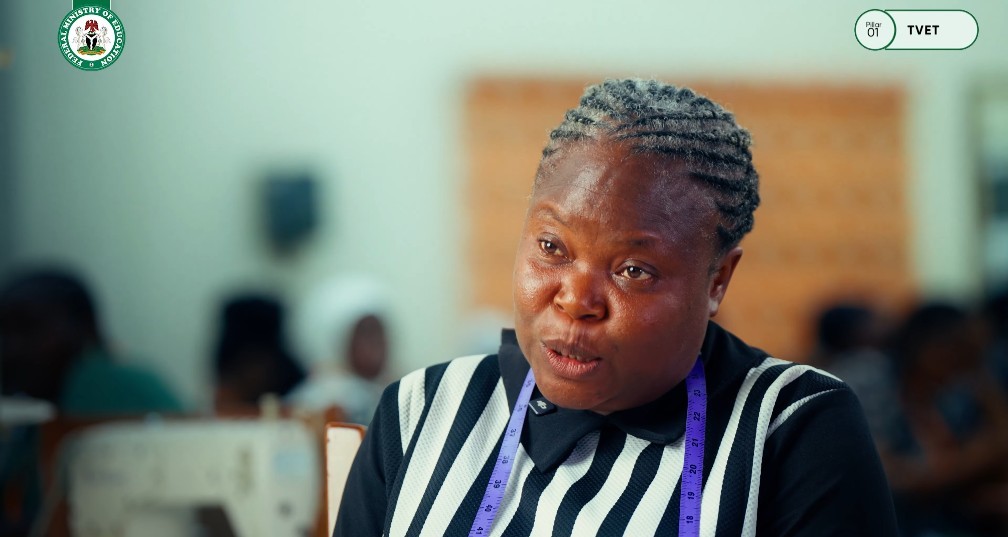
Alausa described TVET as “the foundation for a sustainable national skills development system that links education to employment.”
Pitch, Win, Build: Students Cashing In on Big Ideas
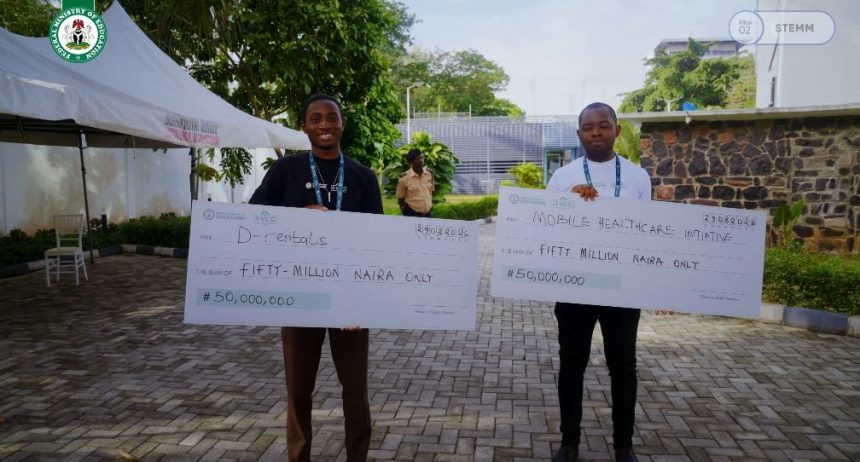
Over 28,000 student innovators from more than 400 institutions applied for the Student Venture Capital Grant, a partnership between the ministry, TETFund and the Bank of Industry. Winners secured up to N50 million to scale their businesses.
Madueke Praise, who won with her Aluta Market venture, described the moment her name was called: “I was shocked… I was shaking. I didn’t know how to walk. I lost my steps.”

Fellow winner Marvel Titoko said the disbelief would have followed him back in time: “If you had woke me up in 2017 and told me that something like this happened, I would have called you a liar.”
The Resident Representative of United Nations Development Programme (UNDP Nigeria), Elsie Attafuah, said the partnership exists because “when we invest in students, we invest in young people, we are creating opportunities.”
Alausa said the grant is proof that “our tertiary institutions are no longer places where you just give lectures… we’re turning our tertiary institutions as centers where we build the next entrepreneurs of the world.”
From Tenant to Landlord: TISSF’s Lifeline for Campus Workers
Before TISSF, many university staff in financial distress had nowhere to turn but predatory bank loans.
Yaba Tech’s Eniola Quadri put it plainly: “If you go to obtain loan from bank, definitely you’re going to pay throughout maybe your lifetime.”
Launched in August 2025, TISSF now offers interest-free loans of up to N10 million, repayable over five years with a one-year moratorium; N11.8 billion disbursed so far.
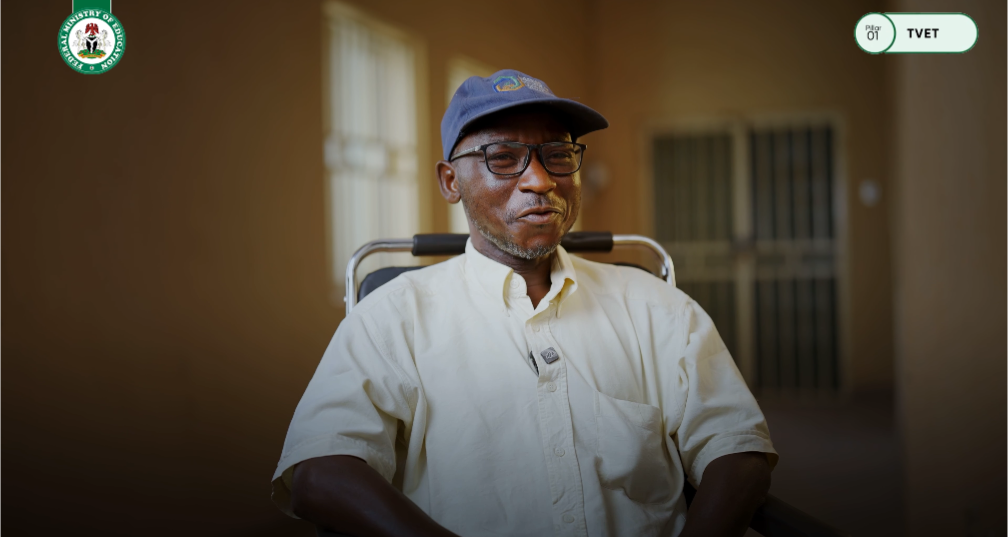
Kano State Polytechnic’s Chief Accountant, Jamilu Ado Sani, said after almost 20 years of service without owning land, “the moment I received that money, my life completely changed… I am now a house owner.”
Yaba Tech Rector Dr Ibrahim Abdul recalled the years before the fund, when “all you can do is to empathize, at times to pray for them” — until, in his words, “Wow. What a kind of relief.”
Teachers’ Reward No Longer in Heaven Only
Nigeria’s education quality push also turned attention to the classroom’s most underappreciated figures: teachers.
Through the annual National Teacher Summit, Universal Basic Education Commission (UBEC) committed over N300 million, rewarding top-performing teachers nationwide with N25 million each.
UBEC Executive Secretary Dr Aisha Garba said the incentive targets “the best performing teachers all around the country.”
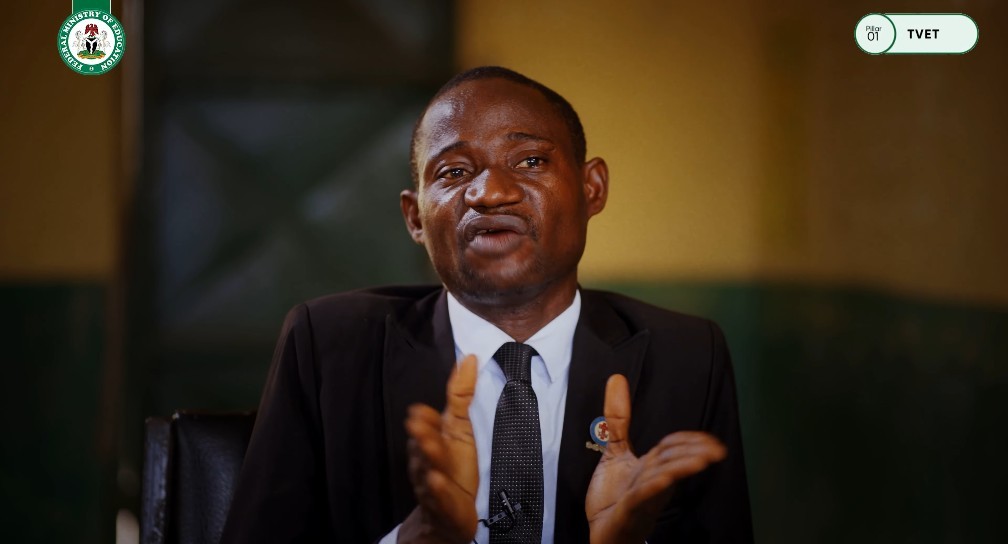
This overall best teacher, from Ansar-Ud-Deen Main School in Ogun State, called the award “a clear affirmation that teaching is important in Nigeria and teachers really matter.”
The best teacher from the South-South, representing St Joseph Primary School in Cross River, Ikoni Blessing Samuel, said she has gone from tenant to landlady.
“I am so grateful and thankful to Federal Government, especially President Bola Ahmed Tinubu… teachers’ reward is not only in heaven, we’ll reap it here on Earth,” she said.

From solar panels to tricycles, workshops to grant cheques, NESRI’s six pillars are stitching together a version of Nigerian education that responds to real, everyday problems.
FURTHER READING
No doubt, sustained funding and follow-through will decide how far this momentum goes. But for the students and teachers already telling their stories, the renewal is no longer a promise, it is already happening.
Philip Ibitoye is a Special Correspondent with EKO HOT BLOG. Click here to find daily analysis and critical insight on trending issues in Lagos and other parts of Nigeria.
Click to watch the video of the week below: