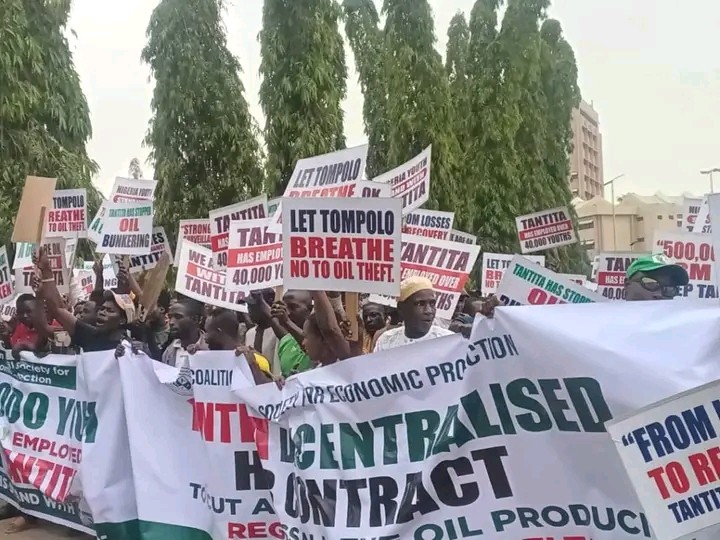
- Scores of demonstrators from the Coalition of Civil Society for Economic Protection gathered at the National Assembly gates on Wednesday, demanding a firm stance against crude oil theft and pipeline vandalism.
- Protesters displayed placards supporting Tantita Security Services Nigeria Limited, urging lawmakers to consolidate the private surveillance framework that has been credited with boosting Nigeria’s oil output.
- The protest coincided with a major parliamentary roundtable featuring top security chiefs, including the Inspector-General of Police and the Chief of Defence Staff, to deliberate on the future of Niger Delta pipeline security.
The National Assembly complex in Abuja became a focal point of civil advocacy on Wednesday as protesters arrived in force to voice their concerns over the state of Nigeria’s oil assets.
Waving placards with messages like “Oil Thieves Are Conspiring Against Tantita” and “Say No to Oil Bunkering,” Eko Hot Blog learnt that the demonstrators urged the federal government to stay the course on its current security strategies.
EDITOR’S PICKS
- Judge Frees 37 Inmates Over Prolonged Detention in Akwa Ibom
- Trump Threatens Iran Over Energy Attacks
- Tinubu Excludes Kemi Badenoch from UK State Visit Itinerary
Although prevented from entering the legislative complex by a heavy security presence, the group’s message was clear: they believe the engagement of private surveillance firms is essential for the economic stability of the Niger Delta and the nation at large.
The timing of the protest was strategic, overlapping with a pivotal parliamentary roundtable organized by the Joint Senate and House Committees on Petroleum Resources.
This high-profile session brought together the country’s most senior security and intelligence leaders, including National Security Adviser Nuhu Ribadu, the Director-General of the DSS, and the Minister of Defence.
The primary agenda of the roundtable was to evaluate the effectiveness of current pipeline security measures and to chart a way forward in the persistent battle against crude oil theft, which continues to bleed the national treasury.
Addressing the media during the demonstration, Tesleem Kolawole, the group’s convener, highlighted the tangible gains made since the introduction of the current surveillance framework.
He noted that Nigeria’s oil production has seen a remarkable rebound, rising from historic lows to approximately 1.84 million barrels per day as of April 2024.
Kolawole argued that disrupting a system that has demonstrably helped stabilize the economy and provided opportunities for Niger Delta youth would be a step backward.
He called for transparency and a results-driven approach to security contracts, rather than bowing to political pressure to decentralize them.
As lawmakers and security chiefs moved into their closed-door deliberations, the presence of the protesters served as a reminder of the public interest in the oil sector’s management.
Crude oil theft remains a complex challenge, involving deep-seated criminal networks and high-level conspiracies.
The outcome of the ongoing parliamentary engagement is expected to influence future policy on how Nigeria protects its most valuable natural resource and manages the delicate balance between military intervention and private sector surveillance in the creeks of the Niger Delta.