
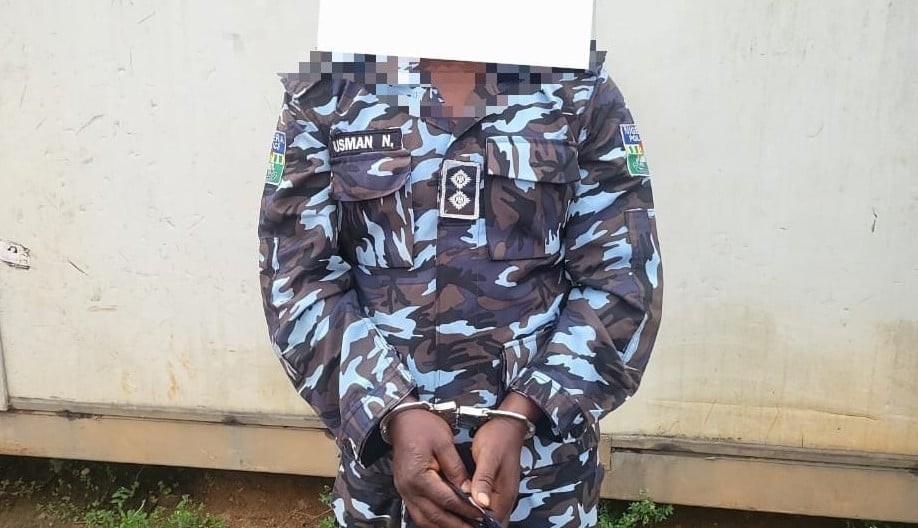
A police officer in Delta State shot a restrained, unarmed suspect dead on Sunday while the man begged for his life. The officer, ASP Nuhu Usman, attached to the Effurun Area Command, did not hesitate. He cocked his rifle and fired at close range while 28-year-old Mene Ogidi sat on the ground, hands tied behind his back, pleading to be taken to Sapele to identify a friend he said had deceived him.
Passersby watched. A camera captured everything. Officers afterwards loaded Ogidi’s body into a police vehicle and drove away.
EDITOR’S PICKS
The video, which circulated widely on social media this week, caused immediate public outrage. By Tuesday, the Delta State Commissioner of Police had arrested Usman, the Force PRO had issued a statement, and the Inspector-General of Police, Tunji Disu, had ordered the officer’s transfer to Force headquarters in Abuja to face a disciplinary committee and possible prosecution.
The institutional response was swift. But the killing itself tells a story that no press statement can paper over.
The Rot Runs Deep
What the Effurun video reveals is not the failure of one rogue officer. It is the portrait of a culture.
(Click to watch the graphic video Ogidi’s execution)
Usman did not shoot Ogidi in a moment of panic or confusion. He shot a man who was already subdued, already cooperative, already posing no threat. He shot him in the presence of colleagues who raised no objection. He shot him while members of the public stood close enough to film the act. And when it was done, the team loaded the body into their vehicle as though the next step in a routine procedure had simply been completed.
That is not an aberration. That is institutional habit — the accumulated weight of decades in which Nigerian police officers have killed civilians with little consequence, operated in communities where their authority was total and their accountability was theoretical, and internalised a working culture in which the rules exist on paper and nowhere else.
Force Order 237, which Usman violated, has existed for years. It has not stopped extrajudicial killings. Neither have previous IGP statements promising zero tolerance, previous disciplinary proceedings, or previous cycles of public outrage followed by institutional silence.
The problem is not that officers do not know the rules. It is that they have learned, through experience, that the rules do not always apply to them.
IGP Disu’s Real Challenge
Disu has brought to the IGP office a reputation for directness and a stated commitment to reform. His response to the Effurun killing — swift arrest, public statement, immediate transfer for prosecution — reflects the instincts of a commander who understands what accountability should look like.
But instincts at the top do not automatically become culture at the bottom. Between the IGP’s office and the officer on the ground in Effurun lies an institution of nearly 400,000 personnel, shaped by decades of poor welfare, political interference, impunity, and public mistrust. Changing that culture requires more than reactive discipline when a video goes viral. It requires sustained, structural intervention — in training, in oversight, in the consequences officers face not only when a camera is present but when one is not.
The Usman case must end in visible prosecution and conviction. That much is owed to Mene Ogidi’s family and to a public that has grown weary of watching justice stall. But Disu and the police leadership must understand that one conviction, however necessary, is not reform. It is, at best, a signal and Nigeria has had signals before.
FURTHER READING
The real work is harder, slower, and less visible than any press statement. That is the challenge now sitting on the IGP’s desk.
Philip Ibitoye is a Special Correspondent with EKO HOT BLOG. Click here to find daily analysis and critical insight on trending issues in Lagos and other parts of Nigeria.
Click to watch the video of the week below: