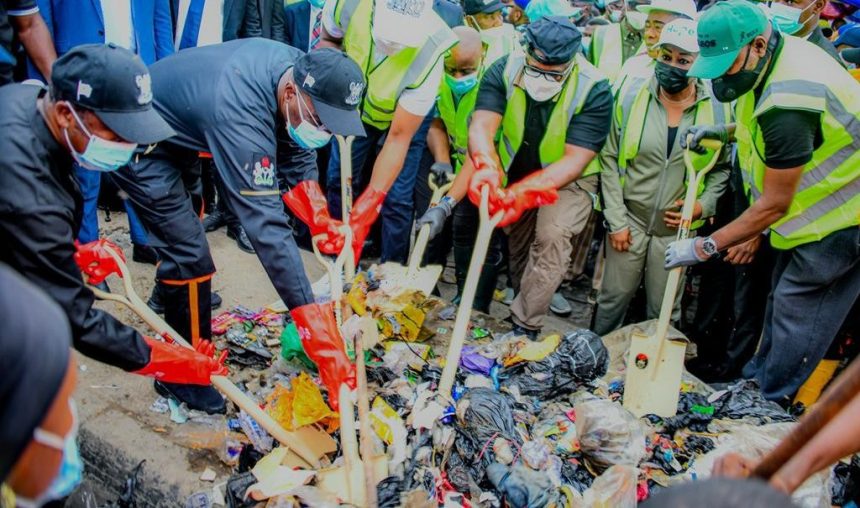
After years of dormancy, Lagos State is reviving its monthly environmental sanitation exercise this Saturday, April 25, and this time, officials say it comes with stricter enforcement.
The exercise, coordinated by the Lagos State Ministry of the Environment and Water Resources, will hold on the last Saturday of every month between 6:30 am and 8:30 am.
EDITOR’S PICKS
There will be controlled movement across the state during this window, meaning residents are expected to remain within their premises and use the period to clean their homes, compounds, streets, and drainage frontages.
Commissioner for Environment and Water Resources, Tokunbo Wahab, who flagged off the programme on March 14 along the Mushin-Agege Motor Road corridor alongside Governor Babajide Sanwo-Olu and Deputy Governor Obafemi Hamzat, described the revival as a collective responsibility.
“A clean city depends not only on government but on the discipline and cooperation of its citizens,” he said in a statement on Wednesday.
Following the symbolic flag off of the monthly environmental sanitation exercise along the Mushin Agege Motor Road corridor on Saturday, March 14th, 2026, I wish to provide further clarity on the modalities of the programme as we prepare for the first exercise on Saturday, April… pic.twitter.com/y0xFw6rU9K
— Tokunbo Wahab (@tokunbo_wahab) April 22, 2026
What the Law Says
Participation is not voluntary. The Lagos State Environmental Sanitation Law (Cap. L27) mandates compliance and prescribes penalties for defaulters.
Two additional statutes reinforce the directive: the Lagos State Waste Management Authority Law, which empowers LAWMA to enforce waste and sanitation standards, and the Public Health Law of Lagos State, which underpins the government’s authority to direct public health actions.
Wahab has confirmed that enforcement officers from the Ministry, the Lagos State Environmental Protection Agency (LASEPA), the Kick Against Indiscipline (KAI) brigade, LAWMA, and local government sanitation inspectors will conduct physical inspections both during and after the two-hour window. Residents found in violation will be sanctioned under the Lagos State Environmental Management and Protection Law of 2017.
What Residents Are Required To Do
The Ministry has outlined specific actions every household must take on sanitation day. Residents are required to inspect the drainage channel at the front and sides of their property and manually clear all silt, leaves, refuse, and debris along the full length of the drain.
All material removed must be bagged and set aside. LAWMA intervention trucks will go around to collect bagged waste generated during the exercise.
As we approach the Monthly Sanitation Exercise day (Saturday, 25th of April, 2026), please take note of these:#CleanerLagos #LagosEnvironmentalSanitation pic.twitter.com/2S02WnNz8r
— Tokunbo Wahab (@tokunbo_wahab) April 22, 2026
Residents are warned not to sweep debris back into drains, and kitchen wastewater, grey water, or sewage must not be discharged into storm drainage channels. Where a major shared drain near a property requires heavy machinery to clear, residents should report this to their Local Government Drainage Unit before sanitation day rather than wait until the exercise is underway.
The ministry has also warned against discharging sewage into public drains, a rule that has already been tested in enforcement actions this year, including the sealing of Access Bank branches found violating sewage disposal regulations.
Incentives and What Comes Next
Beyond sanctions, the state is also introducing a reward component. The cleanest Local Government Area, Local Council Development Area, and cleanest street will each receive recognition, a measure the environment ministry says is designed to encourage healthy competition and community participation.
Officials say the sanitation programme supports Lagos State’s urban renewal agenda under the T.H.E.M.E.S Plus development framework, and aligns with the United Nations Sustainable Development Goal 11 on sustainable cities and communities. The public health rationale cited by the ministry includes reducing cholera, malaria, and typhoid fever outbreaks, clearing blocked drains to limit flooding, and eliminating mosquito breeding grounds in residential areas.
Saturday’s exercise covers all 20 Local Government Areas and 37 Local Council Development Areas across the state. Subsequent exercises will hold on the last Saturday of each month throughout the year.
FURTHER READING
Residents with questions or concerns about shared drainage infrastructure in their area are advised to contact their Local Government Drainage Unit ahead of time.
Click to watch the video of the week below: