- Major European allies, including Italy and Spain, have begun formally rejecting U.S. requests for military base access and asset relocation.
- European leaders argue the offensive against Iran lacks a United Nations mandate and fails to meet the criteria for a war of self-defense.
- The U.S. President has threatened to withdraw future military support for Europe, telling allies they must “start learning how to fight” for themselves.
A diplomatic rift has opened between the United States and its traditional European partners as a growing number of allies refuse to support President Donald Trump’s offensive military campaign in Iran.
Eko Hot Blog reports that the friction reached a flashpoint this week after Italy, led by Prime Minister Giorgia Meloni, previously considered one of Trump’s closest European ideological allies, denied a U.S. request for aircraft to land at a military base in Sicily.
EDITOR’S PICKS
- Judge Frees 37 Inmates Over Prolonged Detention in Akwa Ibom
- Trump Threatens Iran Over Energy Attacks
- Tinubu Excludes Kemi Badenoch from UK State Visit Itinerary
The Italian government cited international law and existing treaty limitations for its refusal, signaling that it views offensive actions against Iran as outside the scope of its agreements with Washington. Italy is not alone in its defiance:
Spain: Prime Minister Pedro Sánchez has prohibited the use of Spanish bases or airspace for any activity related to the war, with his defense minister calling the conflict “profoundly illegal.”
France: President Trump alleged that France blocked U.S. planes carrying military supplies to Israel from using French territory.
Poland: Despite the ongoing threat from Russia, Poland has refused U.S. requests to relocate its Patriot missile batteries from the Ukrainian border to the Middle East.
At the heart of the disagreement is the issue of legality. Experts note that European nations typically require a UN Security Council resolution or evidence of an “imminent attack” to justify offensive military action.
Kamil Zwolski, a fellow at the Royal United Services Institute (RUSI), emphasized that European leaders view NATO as a collective self-defense organization rather than a “toolbox for foreign interventions” that were launched without prior consultation.
President Trump responded to the pushback with a series of sharp rebukes on social media.
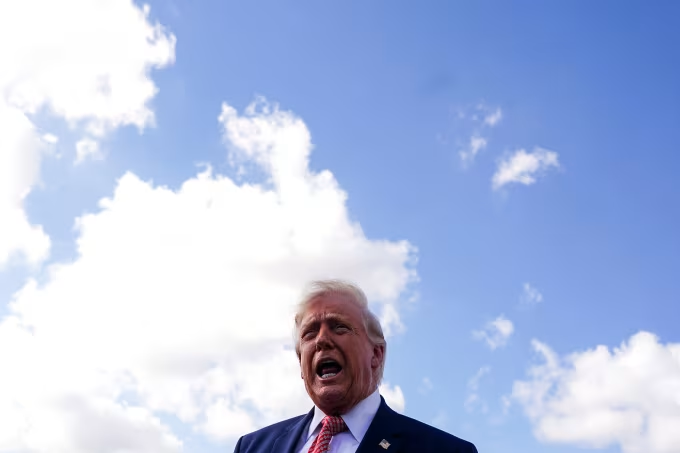
He criticized the United Kingdom for its “refused involvement” and suggested that European nations, which rely on the Strait of Hormuz for energy, should “go get your own oil.”
“The USA won’t be there to help you anymore, just like you weren’t there for us,” Trump posted, casting doubt on the future of the U.S. commitment to European security.
While some nations, particularly the Baltic states remain hesitant to upset Washington due to their proximity to Russia, the broader European consensus appears to be shifting toward de-escalation.
Analysts suggest that while the U.S. remains the primary guarantor of NATO security, the current rhetoric from Washington is causing allies to doubt the reliability of that guarantee.