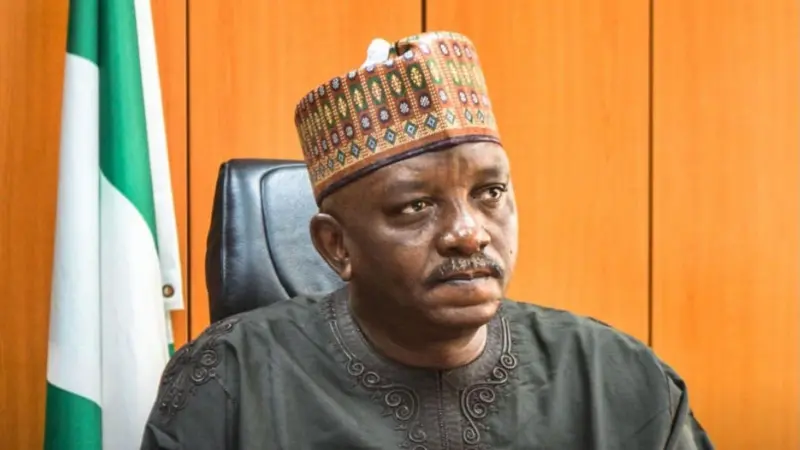
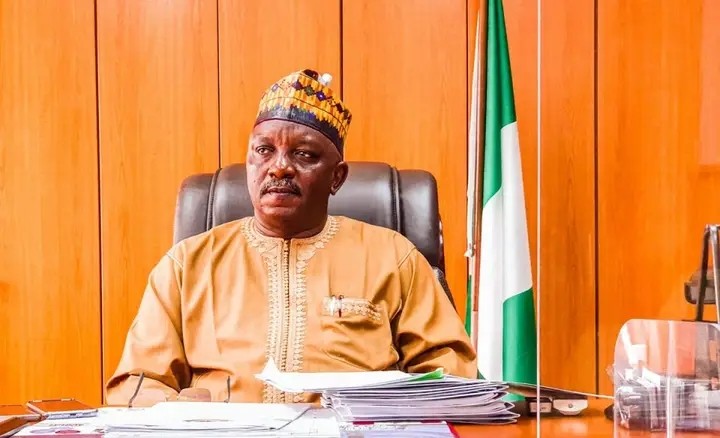
A Federal High Court in Abuja sentenced former Minister of Power, Saleh Mamman, to 75 years in prison on Wednesday.
Justice James Omotosho convicted him on all 12 counts of money laundering and fraud filed by the Economic and Financial Crimes Commission (EFCC), holding that the prosecution proved its case beyond reasonable doubt. The court ordered the terms to run consecutively — not concurrently — and directed security agencies, including Interpol, to arrest Mamman wherever he is found. He was not in court.
EDITOR’S PICKS
The sums involved are serious. Mamman was found to have diverted funds from the Mambilla and Zungeru hydroelectric power projects — infrastructure meant to address Nigeria’s chronic electricity crisis. The court ordered him to refund the outstanding balance from the N22bn the prosecution established was misappropriated, and directed the final forfeiture of properties and foreign currencies linked to him.
When justice reaches the powerful
The verdict matters, at least symbolically. Nigeria has a long history of powerful officeholders escaping accountability — through delayed trials, political connections, or simply disappearing into comfortable exile.
When a court convicts a former federal minister on 12 counts and hands down a 75-year sentence, it signals that the system can, at least occasionally, reach those at the top.
The EFCC has several high-profile cases still in court involving former governors, ministers and other officials. For those defendants and their legal teams, Wednesday’s verdict is a reminder that conviction remains a real possibility. Courts can still rule on evidence, and they can do so firmly.
But pace is everything
A verdict alone is not deterrence. What discourages future corruption is the expectation that wrongdoing will be punished and punished within a meaningful timeframe.
Many of Nigeria’s high-profile fraud cases drag on for years, sometimes decades, before resolution. Mamman was arraigned in July 2024 and convicted in May 2025, which, by Nigerian standards, is relatively swift. That pace matters and should be the norm, not the exception.
Cases that take 10 or 15 years to conclude send a different message: that the system can be outlasted. For anti-corruption prosecution to function as deterrence, trials need to move at a speed that makes accountability feel real and probable, not distant and theoretical.
What anyone who knows Nigeria will note
And yet, a degree of scepticism is warranted.
To begin with, Mamman was sentenced in absentia. Justice Omotosho described his absence as a deliberate attempt to frustrate justice. The court has ordered his arrest. But Mamman does not appear to be in Nigeria, and the history of Nigerian fugitive politicians suggests that international arrest orders can take years to execute if they are executed at all.
More fundamentally, a conviction in Nigeria is not always the end of the story. Orji Uzor Kalu, former governor of Abia State, was convicted in December 2019 and sentenced to 12 years in prison for fraud against the Abia State treasury. He spent roughly six months at a correctional facility before the Supreme Court nullified his conviction on a technicality.
The apex court found that the trial judge, Justice Mohammed Idris, had been elevated to the Court of Appeal before delivering the judgment, and therefore lacked jurisdiction to do so. Kalu walked free. He is today a sitting senator, representing Abia North.
That episode did not involve political interference or an obviously corrupt ruling. It was a procedural technicality, the kind that Nigerian courts have repeatedly allowed to override the substance of well-established facts.
Any conviction, however sound, can be challenged on appeal. And in a legal system where cases routinely travel from Federal High Court to Appeal Court to Supreme Court over many years, a 75-year sentence handed down today may look very different a decade from now.
FURTHER READING
None of this diminishes Wednesday’s verdict. It is significant. But in Nigeria, significance and consequence are not always the same thing.
Philip Ibitoye is a Special Correspondent with EKO HOT BLOG. Click here to find daily analysis and critical insight on trending issues in Lagos and other parts of Nigeria.
Click to watch the video of the week below: