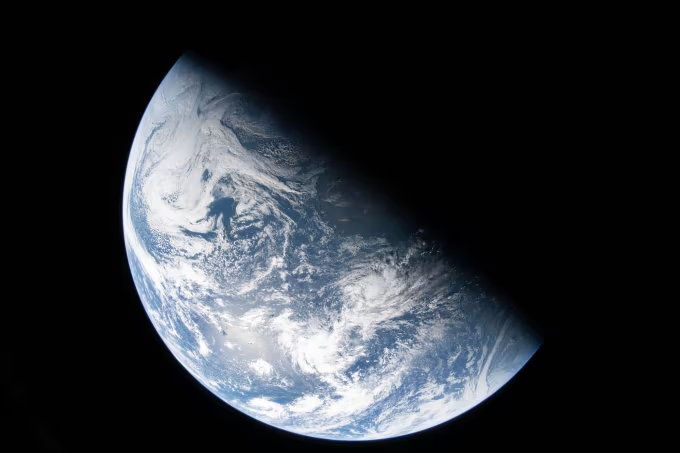
- NASA has released the first images of Earth taken by the Artemis II astronauts from the Orion capsule, featuring a striking “terminator” line dividing day and night.
- Mission Commander Reid Wiseman used a Personal Computing Device to capture the shots, which include rare sightings of auroras and zodiacal light as the spacecraft journeys toward the moon.
- The crew, including Christina Koch and Jeremy Hansen, reportedly delayed their first scheduled space meal because they were too captivated by the view of the entire globe from pole to pole.
NASA’s Artemis II mission has sent back its first beautiful visual reports from deep space released on Friday, April 3, 2026.
Eko Hot Blog reports that the images offer a “pale blue dot” perspective as seen through the eyes of the four astronauts currently making their way to the lunar neighborhood.
EDITOR’S PICKS
- Judge Frees 37 Inmates Over Prolonged Detention in Akwa Ibom
- Trump Threatens Iran Over Energy Attacks
- Tinubu Excludes Kemi Badenoch from UK State Visit Itinerary
The photographs were taken shortly after the completion of the translunar injection burn on April 2.
One particularly vivid shot captures the sun setting behind the Earth, revealing the planet’s nighttime glow sprinkled with electric city lights, framed by the dancing colors of the northern lights at the poles.
Mission specialist Christina Koch shared the emotional impact of the view during a media downlink, noting that while she knew what to expect, nothing prepared her for the sight of the entire planet in a single window pane.
“There’s nothing that prepares you for the breathtaking aspect of seeing your home planet both lit up bright as day and also the moon glow on it at night,” Koch remarked.
Commander Reid Wiseman echoed this sentiment, describing a specific moment when Mission Control reoriented the spacecraft.
He noted that the view was so spectacular it momentarily halted all mission activities.
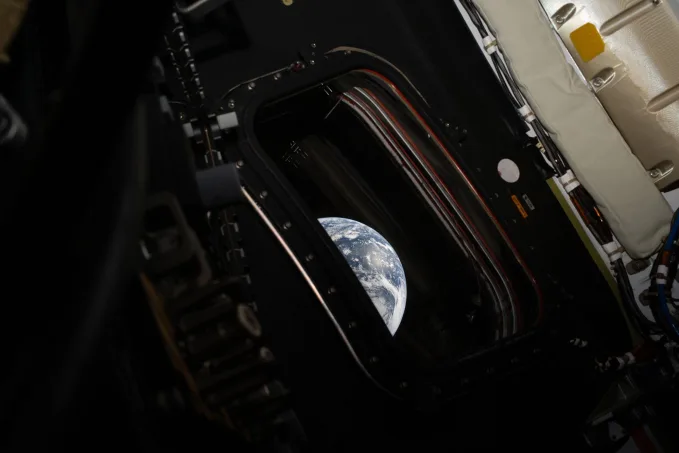
Wiseman even jokingly requested procedures for cleaning the Orion windows, noting they had already become “dirty” from the crew constantly pressing against them to catch a glimpse of home.
The images serve as a poignant reminder of the mission’s scale. While the crew is focused on testing the systems that will eventually return humans to the lunar surface, the initial leg of the trip has been defined by a deep appreciation for the world they left behind.
Canadian astronaut Jeremy Hansen noted that the crew was so mesmerized by the lunar glow on the dark side of the Earth that they could hardly tear themselves away for lunch.
As Artemis II continues its 10-day flight, the crew expects to capture similar close-up views of the lunar surface.
These first Earth-centered images represent the beginning of a new era of deep-space photography, bridging the gap between the Apollo legacy and the future of human exploration.