
Researchers at the Nigerian Institute of Medical Research (NIMR) in Yaba, Lagos, went on an indefinite strike last Thursday, shutting down one of Nigeria’s foremost public health research institutions and threatening to picket its premises.
The Academic Staff Union of Research Institutions (ASURI) declared the action over what it described as the unlawful retirement of senior research directors, a move that, on closer examination, appears to be the result of a dispute over the interpretation of existing public service rules rather than a wilful violation of them.
EDITOR’S PICKS
At the heart of the matter is the Federal Government’s Eight-Year Tenure Policy for Directors, a rule that has been on the books since at least 2014 but whose enforcement has been, by official admission, patchy and inconsistent.
Four directors at the institute received retirement letters from the DG, Professor John Obafunwa, triggering the crisis.
Orders From Above
On February 10, 2026, Mrs. Didi Esther Walson-Jack, Head of the Civil Service of the Federation, issued a circular reaffirming Rule 020909 of the Public Service Rules, 2021 Edition, obtained by EKO HOT BLOG, which mandates that directors across all federal ministries, departments and agencies must retire after eight years in that rank.
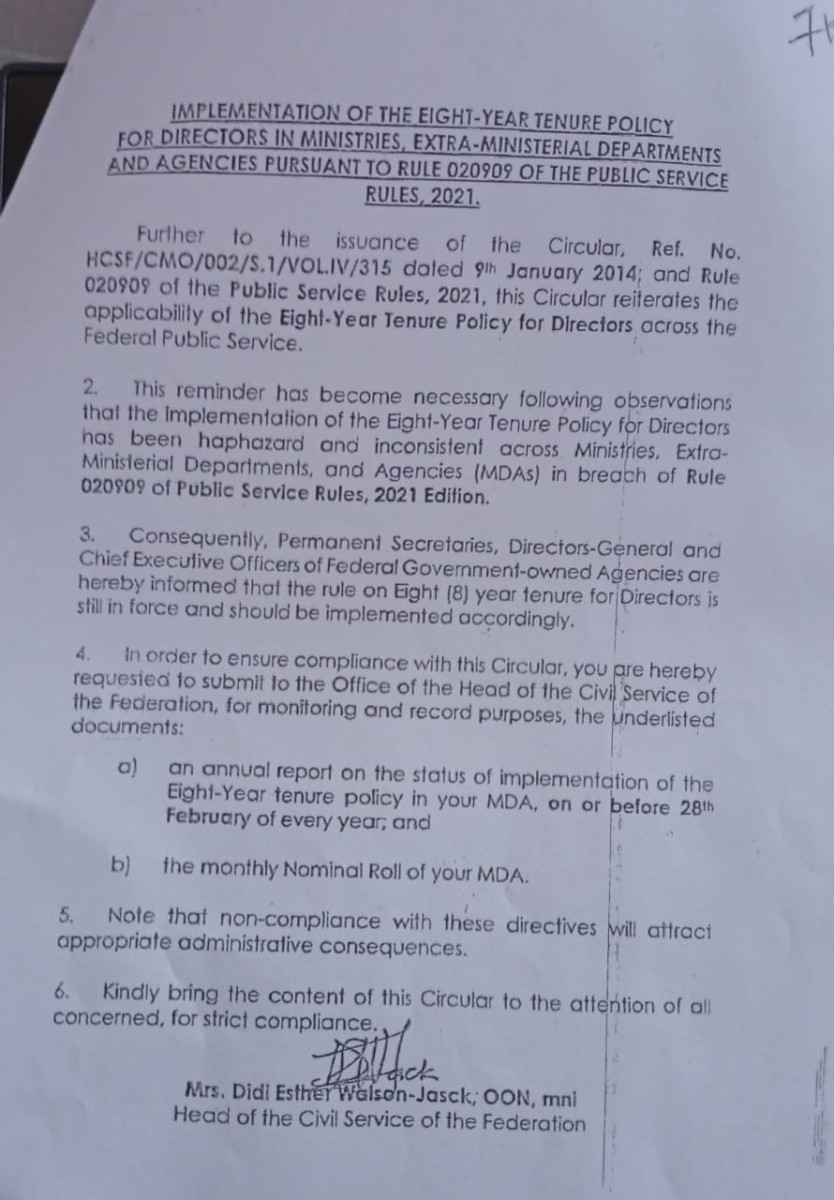
The circular acknowledged, pointedly, that implementation had been “haphazard and inconsistent” across government institutions and directed Permanent Secretaries, Directors-General and Chief Executives to comply without delay, submitting annual status reports and monthly nominal rolls to the Office of the Head of the Civil Service of the Federation (OHCSF).
Six days later, on February 16, the Federal Ministry of Health followed with its own circular seen by EKO HOT BLOG and directed specifically at heads of federal health institutions.
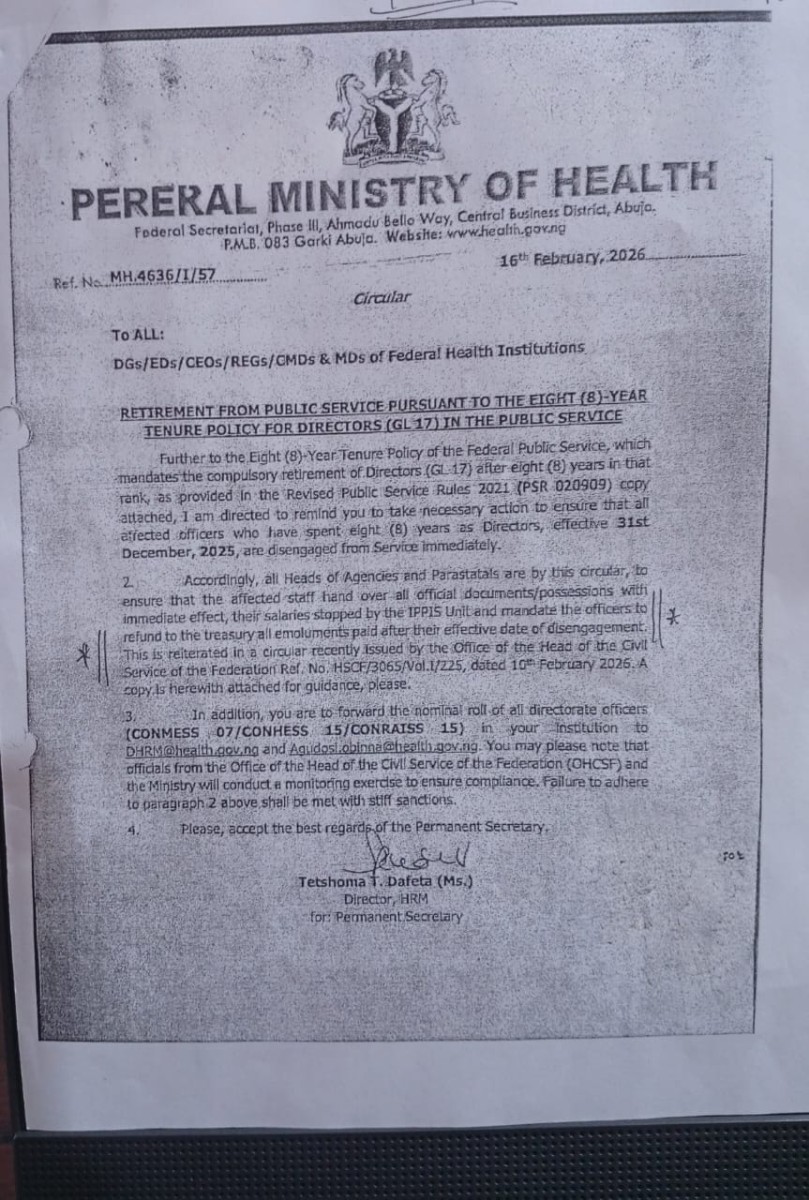
The instruction was that all directors at Grade Level 17 who had spent eight years in rank as of December 31, 2025, were to be immediately disengaged, their salaries stopped on IPPIS, official items handed over, and any emoluments paid after their disengagement date refunded. Non-compliance, the circular warned, would attract “stiff sanctions.”
Both the OHCSF and the ministry added that monitoring exercises would be conducted to verify compliance, a threat that gave agency heads little room to stall.
It was within this context that NIMR’s Director-General, Professor John Obafunwa, issued retirement letters to four directors at the institute.

In response to ASURI’s outcry, the institute’s Director of Administration, Bitrus Nelson, was categorical: management had merely implemented a lawful federal directive. “Any grievance arising from the directives should be referred to the issuing authorities,” he said.
ASURI’s Counter-Argument
ASURI, in its strike notice signed by Secretary-General Professor Theophilus Ndubuaku, rejected this framing entirely.
The union argued that the research and academic cadre — the classification under which NIMR’s affected directors serve — is legally exempt from the eight-year tenure policy, and that this exemption had been formally recognised through prior ministerial intervention.

ASURI further maintained that the valid retirement age for this cadre is 65 years, as established by the OHCSF itself, a position that, if correct, would make the retirements premature regardless of the tenure rule.
The union also accused Obafunwa of allowing a non-academic officer, the Director of Administration, to drive decisions that would, in any comparable university setting, be handled by an academic administrator. NIMR’s Internal Management Committee, which should be populated by academic directors, was alleged to have been left dormant, effectively sidelining the body best placed to navigate exactly this kind of dispute.
ASURI’s most consequential claim is that the matter had already been resolved before the DG acted, that a prior negotiated exemption existed and that management ignored a formal union advisory dated March 3, 2026.
If documentary evidence of that ministerial resolution is ever produced, it would significantly alter the legal and moral weight of the dispute. For now, the union has not made it public.
When The Rules Contradict Each Other
The deepest problem here is structural, and it sits with the federal government.
The 2021 Public Service Rules may well have superseded the 2019 Conditions of Service that ASURI is relying on. But a genuine conflict remains: a director who has completed eight years in rank but has not yet reached 65 years of age occupies a legal grey zone. The tenure rule ends their directorship; the retirement age says they are still owed service. The government has not said which takes precedence.
FURTHER READING
Until that contradiction is addressed — through legislation, a definitive ministerial circular, or judicial interpretation — the standoff at NIMR may not be the last of its kind.
Philip Ibitoye is a Special Correspondent with EKO HOT BLOG. Click here to find daily analysis and critical insight on trending issues in Lagos and other parts of Nigeria.
Click to watch the video of the week below: