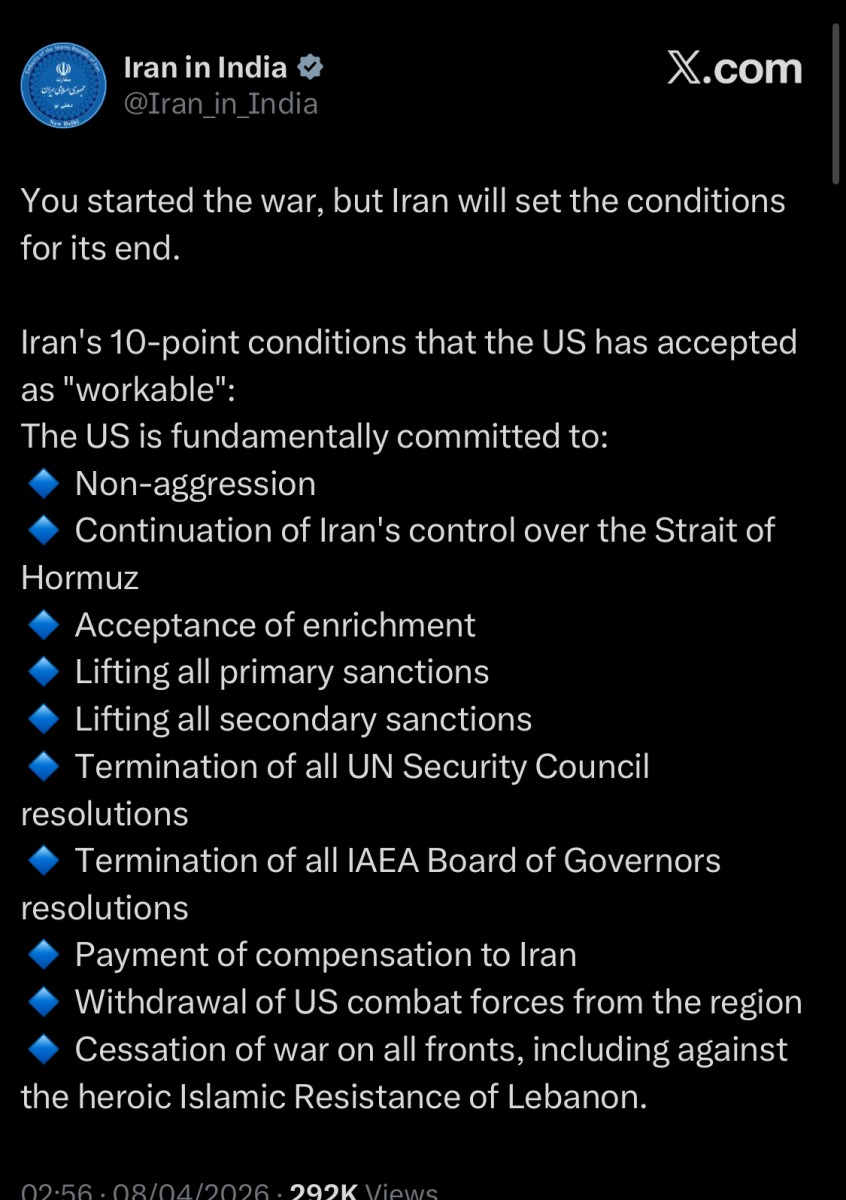
- Following the commencement of a fragile ceasefire, Iran has presented the United States with a 10-point framework for a permanent end to hostilities, asserting that while Washington started the war, Tehran will dictate the terms of its conclusion.
- The conditions include the immediate and total lifting of all primary and secondary U.S. sanctions, recognition of Iran’s uranium enrichment rights, and the termination of all UN Security Council resolutions targeting the country.
- Iran is demanding formal recognition of its sovereignty over the Strait of Hormuz and the withdrawal of all U.S. combat forces from the region as prerequisites for a long-term peace agreement.
The high-stakes standoff between Iran and the United States has entered a critical diplomatic phase following the announcement of a temporary truce.
Through a statement released by its embassy in India, Eko Hot Blog reports that the Iranian government signaled a shift in posture, moving from military engagement to aggressive diplomacy.
EDITOR’S PICKS
- Judge Frees 37 Inmates Over Prolonged Detention in Akwa Ibom
- Trump Threatens Iran Over Energy Attacks
- Tinubu Excludes Kemi Badenoch from UK State Visit Itinerary
The proposed 10-point terms are expansive, seeking not only financial compensation for damages but also a firm non-aggression pact from Washington.
By demanding the complete removal of both primary and secondary sanctions, Tehran aims to dismantle the economic blockade that has long stifled its international trade and domestic growth.
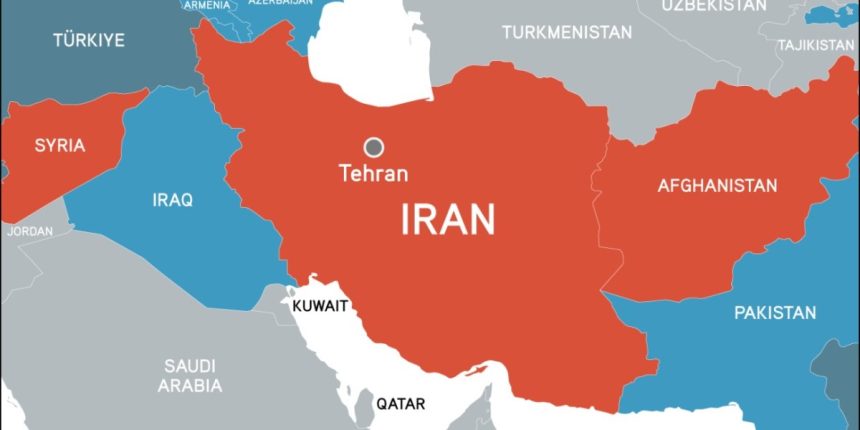
Central to Iran’s conditions is the formal recognition of its control over the Strait of Hormuz, one of the world’s most vital energy arteries.
Any long-term reopening of this chokepoint is now explicitly tied to the U.S. accepting Iran’s nuclear program and ending its military operations against the “Islamic Resistance” across various Middle Eastern fronts, including Lebanon.
This bold framework suggests that Iran is leveraging the global concern over oil prices and energy stability to secure significant concessions that would reshape the geopolitical landscape of the region.
From the American side, President Donald Trump has indicated a willingness to use these points as a foundation for further negotiations.
Following mediation efforts by Pakistani leaders, including Prime Minister Shehbaz Sharif, Trump agreed to a two-week suspension of aerial strikes and ground attacks.
The U.S. President described the situation as being close to a final peace deal, suggesting that many previous points of contention have already been resolved behind the scenes.
However, this suspension is strictly conditional on the immediate and safe opening of the Strait of Hormuz to international shipping.
The two-week window now serves as a high-pressure deadline for both nations to finalize a deal that has broad implications for global security.
While President Trump claims that U.S. military objectives have largely been achieved, the Iranian leadership remains skeptical, as evidenced by recent public protests in Tehran.
The coming days will determine if this “double-sided ceasefire” is the precursor to a historic realignment or merely a temporary pause in a much larger conflict.
For now, the global energy market remains on edge, awaiting a definitive resolution to the blockade of the world’s most critical oil transit route.