- Tinubu Expands Siemens Power Initiative to Three Phases to Boost National Grid
- The President emphasised that the expanded PPI would position Nigeria as a continental leader in energy infrastructure
- Adelabu added that civil works and equipment manufacturing were ongoing for Phase One projects
President Bola Ahmed Tinubu has directed that major transformer substations under the Presidential Power Initiative (PPI) be expanded from two to three phases to boost Nigeria’s national transmission capacity.
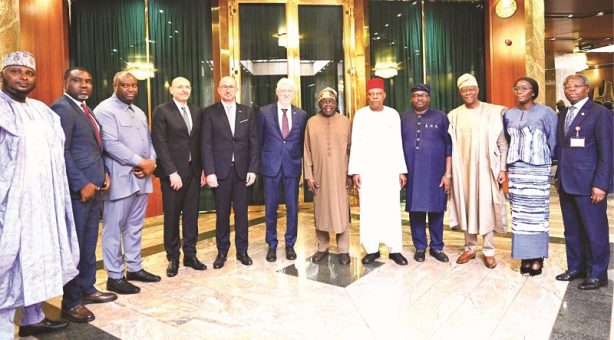
Eko Hot Blog reports that the President gave the directive on Monday during a strategic meeting with a delegation from Siemens Energy at the State House, Abuja. Siemens Energy serves as the technical partner for the three-phase PPI, being implemented through FGN Power Company (FGNPC) as a special purpose vehicle.
EDITOR’S PICK
- Odogbawojo Set to Host 2025 Owu National Convention: A Celebration of Unity and Heritage
- Nigerians Groan As Cooking Gas Price Remains ₦1,800 Per Kg
- Tinubu’s Policies Bringing Progress to South‑East, Says Kalu
According to the Federal Government, more than $2.2 billion in new investments have flowed into the power sector through the initiative, which has also activated 15 state electricity markets.
President Tinubu reaffirmed his administration’s strong commitment to energy reforms, describing reliable electricity as the foundation of industrial growth, job creation, and social development.
“We want everyone to see the glory of our economic recovery and the banishment of poverty,” Tinubu said.
“Our education, healthcare, and transportation all depend on energy, and without steady power, these objectives are impossible. We are taking it very seriously.”
The President emphasised that the expanded PPI would position Nigeria as a continental leader in energy infrastructure, unlocking growth across key sectors.
“There is no industrial growth or economic development without power. I believe that power is the most significant discovery of humanity in the last 1,000 years,” he added.
Present at the meeting were Vice President Kashim Shettima, Minister of Finance and Coordinating Minister of the Economy, Wale Edun, Minister of Power, Adebayo Adelabu, and Special Adviser on Energy, Olu Verheijen.
SECTOR PROGRESS AND INVESTMENTS
Briefing the President, Minister of Power, Adebayo Adelabu, said the PPI has recorded major milestones, including the decentralisation and liberalisation of the power sector and the development of a National Integrated Electricity Policy, the first in 24 years.
He confirmed that since the Accelerated Agreement was signed at COP28 in Dubai (December 2023), Siemens Energy has delivered and commissioned:
- 10 units of 132/33kV mobile substations
- 3 units of 75/100MVA transformers
- 7 units of 60/66MVA transformers
These installations, he said, have added 984 megawatts (MW) of transmission capacity to the national grid, improving stability and reliability.
Adelabu added that civil works and equipment manufacturing were ongoing for Phase One projects in Abeokuta, Offa, Ayede-Ibadan, Sokoto, and Onitsha, with two substations scheduled for completion by end of 2026.
Preparations are also in progress for Phase One–Batch Two, covering six brownfield and ten greenfield substations, expected to deliver a cumulative impact of 4,104MW.
INTERNATIONAL PARTNERSHIP
Wale Edun, Minister of Finance, said the full implementation of the PPI would improve the ease of doing business, create thousands of jobs for young Nigerians, and reduce poverty nationwide.
Dietmar Siersdorfer, Siemens Energy’s Managing Director for the Middle East and Africa, reaffirmed the company’s commitment to Nigeria’s energy future.
He disclosed that two substations under construction would be completed by December 2026, while a new training centre was being developed to expand local capacity in electrical engineering and promote technology transfer.
“The PPI is not just a project but a platform for long-term development and prosperity,” Siersdorfer said, noting that the initiative would transform Nigeria into a regional power hub and strengthen German-Nigerian relations.
A representative of the German Ambassador, Johannes Lehne, also pledged continued partnership and support from the German government.
FURTHER READING
- Anambra: Tension As Soldiers Open Fire On Policemen Returning From Election Duty
- PHOTOS: Fayose, Obasanjo Hold Private Meeting In Ogun
- Hon. Ogunkelu Sylvester Revives Grassroots Hope Through Weekly Empowerment Initiative
Click here to watch video of the week