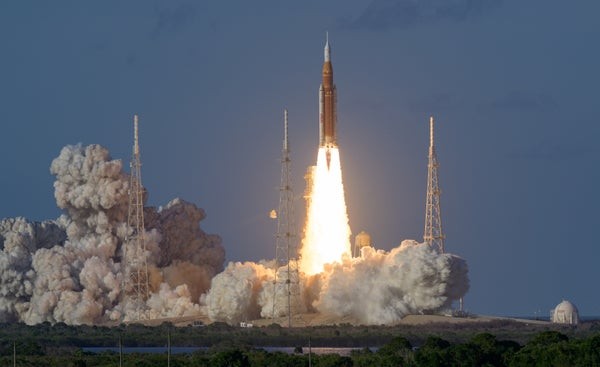
- NASA officials confirmed that the Artemis II mission successfully lifted off at 6:35 p.m. EDT on Wednesday, April 1, 2026, from Kennedy Space Center, marking the first crewed lunar flight in over 50 years.
- Following liftoff, the crew aboard the Orion spacecraft briefly lost communication with mission control, but NASA Administrator Jared Isaacman confirmed that contact has been fully re-established.
- The spacecraft, named Integrity, has completed its “apogee raise burn” to stabilize its orbit and is preparing for the critical trans-lunar injection burn that will propel it toward the moon.
Following a thunderous departure from Earth, NASA’s Artemis II crew is reportedly in “great spirits” as they begin their ten-day journey around the moon.
Eko Hot Blog reports that the mission, carrying astronauts Reid Wiseman, Christina Koch, Victor Glover, and Jeremy Hansen, represents a pivotal step in NASA’s goal to establish a permanent lunar presence.
EDITOR’S PICKS
- Judge Frees 37 Inmates Over Prolonged Detention in Akwa Ibom
- Trump Threatens Iran Over Energy Attacks
- Tinubu Excludes Kemi Badenoch from UK State Visit Itinerary
During a post-launch press conference, NASA Administrator Jared Isaacman addressed a momentary loss of communication between the Orion capsule and Earth-based controllers.
He reassured the public that the issue was quickly resolved and that the crew is currently “safe and secure.”
The spacecraft is now coasting in Earth’s orbit, having successfully performed a maneuver to stabilize its path.
The next major hurdle is the trans-lunar injection burn, scheduled for the next 24 hours, which will provide the necessary velocity to break free of Earth’s gravity and head toward the lunar far side.

While the mission will not involve a lunar landing, the crew has a packed schedule. Over the next ten days, they will:
- Test Orion’s Systems: This includes evaluating the spacecraft’s life support and a new, cutting-edge space toilet designed for simultaneous use.
- Monitor Human Health: The astronauts will measure how their bodies adapt to microgravity and deep-space radiation.
- Eclipse from Above: In a unique orbital alignment, the crew is expected to witness the moon pass in front of the sun, offering a rare view of the solar corona from space.
NASA officials have described Artemis II as the “opening act” for a new era of exploration. While this mission stays in orbit, it paves the way for Artemis IV in 2028, which aims to return humans to the lunar surface.
“After a brief, 54-year intermission, NASA is back in the business of sending astronauts to the moon,” Isaacman remarked.
The crew is currently slated to perform their lunar flyby on April 6, with a planned splashdown back on Earth on April 10.